CFI Endorsements Cheat Sheet: AC 61-65K Decoded (Every Endorsement You’ll Sign in Your First Year)

A CFI endorsement is an authorized instructor’s signed logbook entry attesting that a pilot meets a specific 14 CFR Part 61 requirement — solo flight, knowledge test, practical test, flight review, instrument proficiency check, or an additional aircraft category. Each endorsement is a legal signature under 14 CFR 61.59. The sample language lives in AC 61-65K (current November 2025); the judgment about when to sign is the actual job.
I’m Chris Palmer — two-time Master Aviation Educator, Gold Seal CFI, founder of Angle of Attack. Here’s the working list of CFI endorsements you’ll sign in your first year, decoded into plain English, with the gatekeeper moments most cheat sheets skip.
- Every CFI endorsement is a legal signature under 14 CFR 61.59 — a false or careless endorsement can cost you every certificate you hold.
- AC 61-65K — issued November 14, 2025 — is the current FAA source for sample endorsement language. It replaces AC 61-65J. Anything still citing J is out of date.
- The working set of CFI endorsements is about 25–30 (not the 100+ in the AC’s appendix). Most live in five buckets: student pilot, knowledge/practical tests, additional aircraft, flight review/IPC, and CFI add-ons.
- Under 14 CFR 61.189, you must keep the record of every solo and practical-test endorsement for 3 years. If something goes wrong and you can’t produce the file, you can’t defend the signature.
- The §61.183(i)(1) spin training endorsement (the stall/spin proficiency one) is the most-missed endorsement on initial CFI checkrides — candidates fail in the first 10 minutes of the oral because they didn’t bring it.
- The most important endorsement you’ll ever give is the one you didn’t — the day you held the line when the pressure said sign.
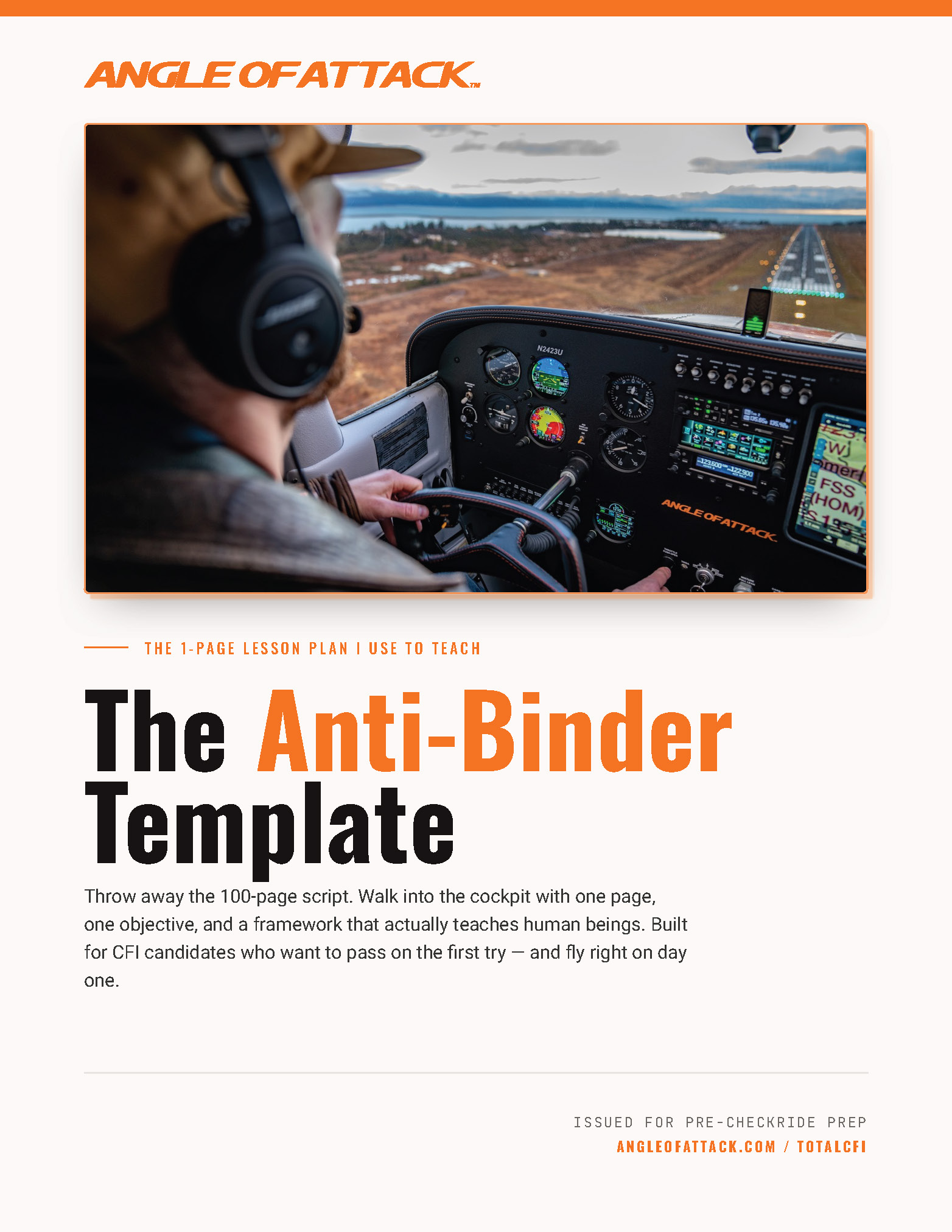
Walking into your first lesson with a 50-page binder won't help you.
Get my Anti-Binder One-Page Lesson Plan Template free — the lesson plan tool I built for CFI candidates who want to be ready Day 1.
Get the Anti-Binder Template Free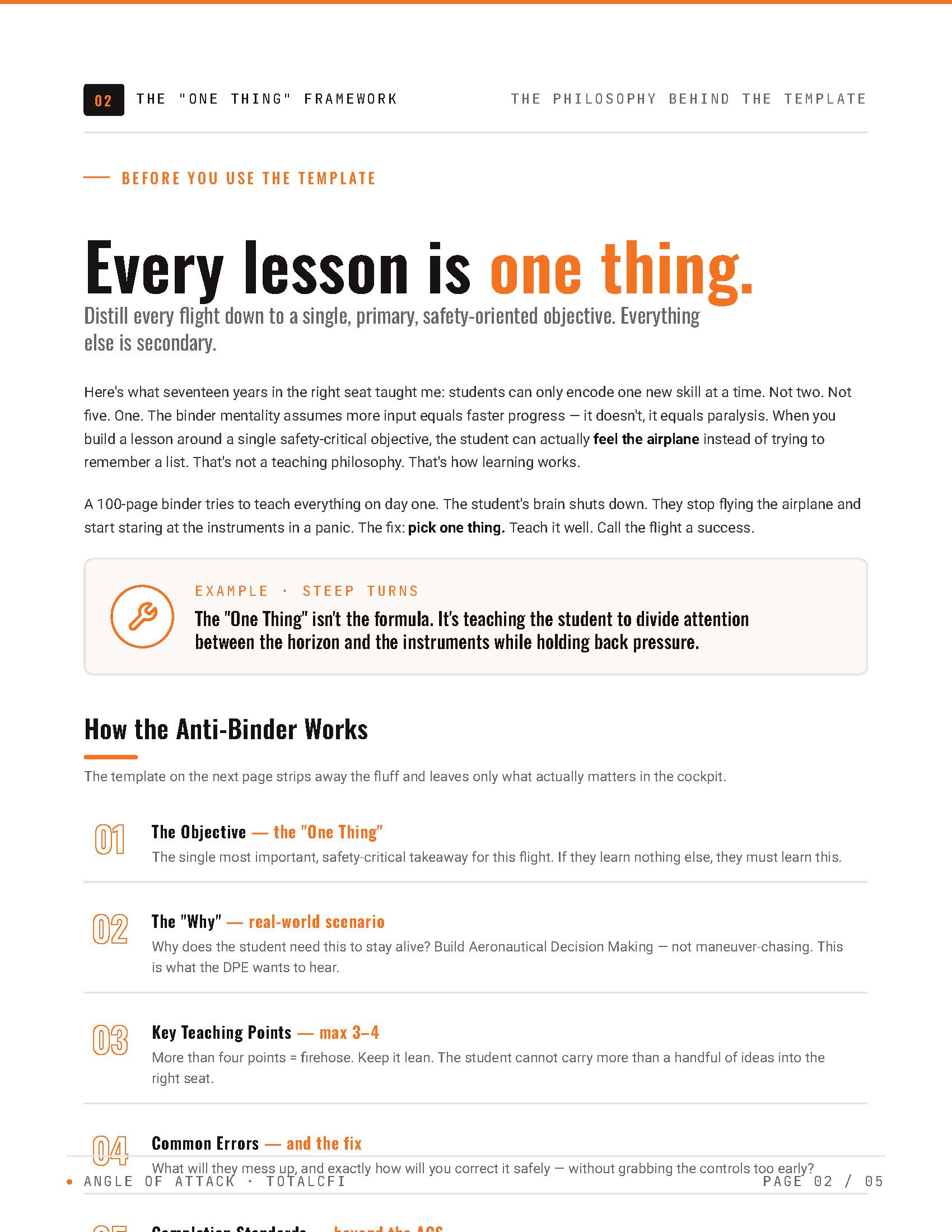
WHAT'S IN THIS GUIDE
- 1What Is a CFI Endorsement? (And Why Each One Is a Legal Signature)
- 2How Many CFI Endorsements Are There? (And Why Most Lists Are Misleading)
- 3The Student Pilot Endorsements (The Seven You’ll Sign Most)
- 4Private, Instrument, and Commercial Endorsements
- 5What You Sign vs. What the Student Does (The Gatekeeper Map)
- 6Flight Review and IPC Endorsements (The Ones Every CFI Gives Forever)
- 7CFI / CFII / MEI Initial and Renewal Endorsements
- 8Do CFI Endorsements Expire? (Yes — Here’s the Cheat Sheet)
- 9When Not to Sign: The Gatekeeper Moments Nobody Talks About
- 10What Happens If You Give a Bad Endorsement?
- 11Where to Find the Canonical Source (AC 61-65K + Cross-References)
- 12Frequently Asked Questions
What Is a CFI Endorsement? (And Why Each One Is a Legal Signature)

A CFI endorsement is your signed logbook entry — name, certificate number, expiration, date — attesting that a pilot meets a specific Part 61 requirement. Solo. Knowledge test. Practical test. Flight review. Complex. Tailwheel.
Every one of those is the same thing legally — a signature under 14 CFR 61.59:
“No person may make or cause to be made… any fraudulent or intentionally false entry in any logbook, record, or report that is required to be kept, made, or used to show compliance with any requirement for the issuance or exercise of the privileges of any certificate, rating, or authorization under this part…” — 14 CFR 61.59(a)(2)
The FAA enforces it hard. Standard penalty for intentional falsification is revocation of every certificate you hold — not just the CFI. Under §61.13(d)(2), you can’t reapply for a year. “The school owner pushed me” is not a defense. If you’re prepping for that signature for the first time, the how to become a CFI guide carries the full prerequisite stack.
And the paper trail. 14 CFR 61.189 requires keeping every solo and practical-test endorsement on file for three years. The FSDO calls year three — if you can’t produce the record, you can’t defend the signature. The record IS the defense.
Carry this frame through the rest of the article. An endorsement is a legal statement about a pilot’s readiness — not a logbook entry. Backed by your certificate. On file for three years. The list is the easy part. The judgment is the job.
The certificate the student earns is a license to learn — the beginning, not the end. That’s a real thing to put your name on.
How Many CFI Endorsements Are There? (And Why Most Lists Are Misleading)

Open AC 61-65K and Appendix A has over 100 sample endorsements — sport pilot, recreational, private, instrument, commercial, ATP, flight instructor, ground instructor, glider, balloon, type ratings, plus K’s new MOSAIC sport pilot additions.
But the working set for a first-year CFI at a Part 61 airplane school is about 25 to 30. The rest is sport pilot, glider, balloon, ATP, and edge cases you may never touch.
That working set lives in five buckets:
- Student pilot endorsements — pre-solo through solo cross-country. The seven you’ll sign most.
- Knowledge and practical test recommendations — the sign-offs that get a pilot in front of the FAA or a DPE.
- Additional aircraft — complex, high-performance, high-altitude, tailwheel. One-time, per §61.31.
- Flight review and IPC — the recurrence endorsements every career CFI gives for the rest of their working life.
- CFI / CFII / MEI add-ons — stall-awareness, spin, instrument-instructor, qualifying-instructor.
I’m not pasting the AC. That’s what every other CFI endorsements guide does, and it’s why most don’t actually help you do the job. The AC has the words. This article has the working list — and the moments where the signature matters more than the wording.
The Student Pilot Endorsements (The Seven You’ll Sign Most)
These seven are the ones you’ll touch most often — the path from discovery flight to solo cross-country sixty miles from home. The regs behind them are 14 CFR 61.87 (pre-solo and solo), §61.89 (student limitations), §61.93 (solo cross-country), and §61.95 (Class B solo).
| # | Endorsement | FAR | AC 61-65K | What you’re certifying | Expires | Verify before signing |
|---|---|---|---|---|---|---|
| 1 | Pre-solo aeronautical knowledge | §61.87(b) | App. A | Student took the written, you graded it, you reviewed every wrong answer | No expiration (test attestation) | Reviewed every wrong answer — §61.87(b)(2)(ii) requires it |
| 2 | Pre-solo flight training (per make/model) | §61.87(c) | App. A | Student proficient in maneuvers required for solo in THIS aircraft | 90 days | Same make/model student will solo |
| 3 | First solo (per make/model) | §61.87(n) | App. A | Student authorized to operate THIS aircraft in solo flight | 90 days | Pre-solo training endorsement current; student meets §61.89 |
| 4 | Solo to airport within 25 NM | §61.93(b)(1) | App. A | Solo to a specific airport within 25 NM | 90 days | Airport named; student briefed on airspace, weather, NOTAMs |
| 5 | 90-day solo currency renewal (per make/model) | §61.87(p) | App. A | Renews solo endorsement after prior 90 days | 90 days | Recent flight training in make/model; student still meets §61.89 |
| 6 | Solo cross-country (one-time, category) | §61.93(c)(1) | App. A | Student completed all solo XC training requirements | One-time per category | Every §61.93 training item logged |
| 7 | Solo cross-country (per flight) | §61.93(c)(3) | App. A | You reviewed THIS flight’s planning; student ready for THIS flight | This flight only | Weather, NOTAMs, fuel, route, alternates, performance |
Note: the Class B solo endorsement (§61.95) is a separate eighth endorsement — intentionally not in the “core seven” because it only applies near Class B airspace. If you teach in a Class B veil, treat it as the same-tier essential.
Three things the table doesn’t show that you need to carry.
Pre-solo and first-solo are make-and-model specific. A Cessna 172 endorsement does not authorize a Piper Cherokee solo. Series variations within the same make/model — 172R vs. 172S — are covered.
Class B operations under 14 CFR 61.95 is a separate endorsement from the 25-NM-to-another-airport endorsement in §61.93(b)(1). Different reg, different scope. Most CFI endorsements articles online conflate them.
The per-flight cross-country endorsement (row 7) is the one new CFIs miss. It isn’t endorse-once-and-forget. Every solo cross-country flight needs its own per-flight review of the student’s planning. Weather, NOTAMs, fuel, route, alternates, performance. Every. Single. Flight.
Watch one of my students’ first solo from a year ago — the moment after the pen lifts off the logbook:
Private, Instrument, and Commercial Endorsements

Past first solo, the endorsements shift from “is this person safe to fly alone” to “is this person ready for the next regulatory milestone.” Two drive this phase — the knowledge test recommendation and the practical test recommendation.
New CFIs get the practical-test recommendation wrong more than any other. Under 14 CFR 61.39(a)(6), the endorsement is valid “within the 2 calendar months preceding the month of application” — NOT “60 days.” If the student applies in May, the endorsement is valid if signed in March or April. The “60 days” you’ll hear at flight schools comes from §61.43 (retest after a discontinued practical). Different rule.
| Endorsement | FAR | AC 61-65K | When you sign | One-time/recurring |
|---|---|---|---|---|
| Knowledge test recommendation | §61.35 | App. A | After student is prepared for the FAA written; results valid 24 cal. months | Per cert/rating |
| Practical-test recommendation | §61.39(a)(6) | App. A | Within 2 calendar months preceding the month of application | Per checkride |
| Flight proficiency (Areas of Operation) | §61.105 / .107 / .109 / .127 | App. A | Training logged in each ACS Area of Operation | Per cert/rating |
| Complex airplane | §61.31(e) | App. A | After ground + flight in complex (retractable + flaps + CSU prop) | One-time |
| High-performance (>200 HP) | §61.31(f) | App. A | After ground + flight in HP airplane | One-time |
| High-altitude (pressurized, >25,000 MSL) | §61.31(g) | App. A | After ground + flight on high-altitude ops | One-time |
| Tailwheel | §61.31(i) | App. A | After flight training in tailwheel; no minimum hours | One-time |
| Additional category/class | §61.63 | App. A | Proficiency check + aeronautical experience | Per rating |
The §61.31 add-ons are one-time — once endorsed, the privilege is lifetime. Grandfather clauses cover pilots who logged time in those airplanes before the rules came in (complex/HP before August 4, 1997; tailwheel before April 15, 1991), but in 2026 you’ll rarely meet anyone covered.
One practical note. Insurance carriers want documented recent training in complex and tailwheel airplanes before writing a policy, even when the FAA endorsement is decades old. Your §61.31 endorsement satisfies the FAA forever. The insurance company is a separate conversation.
What You Sign vs. What the Student Does (The Gatekeeper Map)
Here’s the table no competing article carries. Every endorsement does three things at once — gives the student a privilege, commits you to a record under §61.189, puts your signature on the line under §61.59.
| Endorsement | Student privilege gained | CFI’s record-keeping obligation |
|---|---|---|
| Pre-solo flight training (§61.87(c)) | Eligible for first solo in the specified make/model | 3-year record per §61.189 |
| First solo (§61.87(n)) | PIC solo authority, make/model, 90 days | 3-year record per §61.189 |
| Solo to airport within 25 NM (§61.93(b)(1)) | Solo to a specific named airport within 25 NM | 3-year record; airport named in file |
| Solo cross-country, per flight (§61.93(c)(3)) | Authorized to conduct THIS specific flight | 3-year record; route/date documented |
| Knowledge test recommendation (§61.35) | Eligible for the FAA written for that certificate/rating | 3-year record (per practical-test side) |
| Practical-test recommendation (§61.39(a)(6)) | Eligible for FAA practical test within 2 calendar months | 3-year record per §61.189 |
| Complex / HP / High-altitude / Tailwheel (§61.31) | Lifetime PIC privilege in that category | Training record (insurance may request) |
| Flight review (§61.56) | 24-month flight review currency restored | Logbook entry; 3-year record by policy |
| IPC (§61.57(d)) | Instrument currency re-established | Logbook entry; record by policy |
| Spin training proficiency (§61.183(i)(1)) | CFI applicant eligible for initial practical | Endorsing CFI’s file; DPE cites it |
Every signature creates two things at once: a privilege for the student and a paper trail for you. The student walks away with a new freedom. You walk away with a file you keep, defend, and produce on demand for three years. That’s the difference between “I signed a logbook” and “I gave an endorsement.”
You won’t memorize the map. You’ll internalize the principle: every endorsement is a privilege backed by a record I keep and a signature I’m defending.
Flight Review and IPC Endorsements (The Ones Every CFI Gives Forever)

Most endorsements happen during initial training. Two happen for the rest of a pilot’s flying life — flight review and instrument proficiency check. If you become a career CFI, these two outnumber every other endorsement by an order of magnitude.
Flight Review (§61.56)
The flight review under 14 CFR 61.56 is the 24-month checkup every pilot needs to keep acting as PIC. Minimum: one hour ground + one hour flight, covering Part 91 plus the maneuvers needed to safely exercise the privileges of the certificate. No FAA-defined pass/fail — the CFI either endorses satisfactory completion or doesn’t.
The exact AC 61-65K sample endorsement language for §61.56(c) reads:
“I certify that [First name, MI, Last name], [grade of pilot certificate], [certificate number], has satisfactorily completed a flight review of 14 CFR § 61.56(a) on [date].” — AC 61-65K, Appendix A.69 (§61.56(a) and (c))
Sign in the logbook with name, certificate number, type, and expiration. The logbook entry is the evidence.
Watch for exceptions. A pilot who passed a practical test or proficiency check within the prior 24 calendar months gets credit. Same for a completed Wings phase. The pilot brings you the logbook entry showing the basis. Don’t take their word for it.
Instrument Proficiency Check (§61.57(d))
The IPC is different. Under 14 CFR 61.57(d), it’s required when a pilot has been out of instrument currency for six months PLUS the six-month grace period without re-establishing currency. Twelve months total from the last currency event.
The IPC must cover every Area of Operation in the Instrument Rating ACS — the full list, not a sampler. It’s the legal reset on instrument proficiency.
Who can administer? An FAA inspector, military instrument check pilot, FAA-approved check pilot, or any CFI holding an instrument rating on their flight instructor certificate. As a fresh CFII, you can give IPCs.
Use the AC 61-65K Appendix A endorsement language for both. Don’t write your own.
CFI / CFII / MEI Initial and Renewal Endorsements

This is the section most CFI candidates underweight on their own checkride prep — and the one that fails them in the first 10 minutes of the oral. Before the endorsement stack matters, the eligibility stack must be in place — see the full CFI eligibility requirements for the prerequisites.
The Initial CFI Endorsement You’re Going to Forget
Under 14 CFR § 61.183(i), every initial flight instructor applicant for an airplane (or glider) category rating must have a logbook endorsement attesting to instructional proficiency in stall awareness, spin entry, spins, and spin recovery procedures. The sample language is in AC 61-65K Appendix A.49.
One layer deeper: the instructor who provides the training leading up to your CFI checkride must meet the qualifications in 14 CFR § 61.195(h) — broadly, they must have held their flight instructor certificate for at least 24 calendar months and have given at least 200 hours of flight training (for airplane category). That’s a separate gate from the endorsement itself, but it’s the one that fails CFI applicants on checkride day when they discover the instructor who signed them off didn’t qualify.
Two things to bring to your initial: (1) the spin/stall endorsement under §61.183(i)(1), and (2) the practical-test recommendation under §61.39(a)(6) from an instructor who meets §61.195(h).
This is the most-missed endorsement on CFI checkrides. Candidates show up, hand the DPE the packet, and the DPE finds the endorsement either missing or signed by an instructor who didn’t meet the 24-month qualifying-instructor rule. Ten minutes in, the oral is over. For the full picture of how the rest of the oral unfolds, see the CFI checkride pillar guide.
The spin training endorsement at §61.183(i)(1) is the one that lives in AC 61-65K Appendix A.49 — study its sample language separately when prepping your own CFI ride.
CFI Renewal — All Six Pathways Under §61.197
A working CFI must exercise the privileges of the certificate within the preceding 24 calendar months — the §61.197 recency window. Effective December 1, 2024, the FAA stopped issuing flight instructor certificates with an expiration date. Certificates issued on or after that date show a “recent experience end date” (REED) instead; older certificates retain their printed expiration until exchanged at the next recent-experience submission. Either way, what controls is the §61.197 recency requirement: exercise the privileges within the preceding 24 calendar months, or the privileges lapse.
The six pathways under 14 CFR § 61.197. Most cheat sheets list two:
- Pass a practical test for the CFI certificate or any additional flight instructor rating.
- Endorse ≥5 students for practical tests in the preceding 24 calendar months, with ≥80% passing on first attempt (your students, not your school’s pass rate).
- Serve as a flight instructor in a Part 121 or 135 operation — as a company check pilot, chief flight instructor, or in any position involving the regular evaluation of pilots.
- Complete an approved Flight Instructor Refresher Course (FIRC) within the preceding 3 calendar months.
- Pass a military instructor proficiency check (U.S. Armed Forces).
- Serve as a flight instructor in the FAA-sponsored WINGS Pilot Proficiency Program — conducting at least 15 flight activities with at least 5 different pilots in the preceding 24 calendar months.
Most working CFIs renew via FIRC. 16 hours online, done. The 80% pathway is the most prestigious — renewal earned by what your students did, not what you sat through.
Do CFI Endorsements Expire? (Yes — Here’s the Cheat Sheet)
Yes. Some expire in 90 days, some in 24 months, some in 2 calendar months, some never.
| Time class | Endorsements | Regulatory phrase |
|---|---|---|
| 90 days | Pre-solo flight training, first solo, 90-day solo renewal, solo to airport within 25 NM, Class B solo, night solo | “within the preceding 90 days” |
| 2 calendar months | Practical-test recommendation (NOT “60 days”) | “within the 2 calendar months preceding the month of application” |
| 24 calendar months | Flight review, knowledge test result validity | “within the preceding 24 calendar months” |
| One-time | Complex (§61.31(e)), HP (§61.31(f)), high-altitude (§61.31(g)), tailwheel (§61.31(i)) | No expiration — insurance may require recent training |
| Per-flight | Per-flight solo cross-country review (§61.93(c)(3)) | “the student is prepared to make the flight safely” |
The 90-day clock bites new CFIs hardest. Student gets the first solo endorsement March 1. Flies weekly through April. May 1 they’re soloing on schedule. Then weather pushes a checkride back, the student goes on vacation, June 1 quietly comes and goes — the clock expires.
The fix is calendar discipline. Every solo endorsement, IPC, and flight review goes on a calendar — paper, digital, whatever you’ll actually look at — with the expiration date a week before the 90 is up. You’re not memorizing the clock. You’re refusing to be surprised by it.
When Not to Sign: The Gatekeeper Moments Nobody Talks About
Nobody writes this section. Every CFI endorsements article on the internet is a list of what to sign and when. The harder question is when not to sign.
The pressure is constant. Student’s family is in town for the solo. Flight school owner is watching throughput. DPE schedule has a hole next week. Your own people-pleasing instinct is loud — they’ve worked hard, who am I to hold them back.
Sign because the standard is met. Don’t sign because it isn’t. Three questions I run before any endorsement:
- Does the student meet the regulatory standard? (The box. Did they take the quiz? Fly the maneuver to ACS? Prerequisites logged?)
- Would I be proud of how this pilot performs if a DPE evaluated them today? (The judgment. Not “could they probably pass.” Would I be proud.)
- If something goes wrong this week, can I produce the §61.189 record AND defend the signature with a clear conscience? (The gatekeeper. Three years from now in a deposition, can I look up from the file and say “I made the right call.”)
Three yeses, you sign. Any no, you wait. Re-train, re-quiz, re-evaluate. Then run the three again.
Saying “not yet” is the move. The most important coaching move you make in your first year. Not “you failed.” Not yet. Future tense. Concrete plan to close the gap. Student leaves knowing exactly what to do next.
The student doesn’t lose the certificate because you didn’t sign. They lose the flight today. There’s a difference.
This is the work I walk through inside TotalCFI — how to run the decision conversation when the student is pushing for the endorsement and you’re not yet ready to give it. The framework above is the cheat sheet; the course is the language and the practiced drills.
Watch a student in the moment that precedes a solo endorsement — and ask what question you’re asking before you sign:
Professionalism is not a certificate — it’s behavior. The first time you hold the line under pressure is the day you become the CFI students remember twenty years later. The pen in your hand is the most consequential pen in the building. Use it that way.
What Happens If You Give a Bad Endorsement?

Most of the time, nothing visible. The student passes the checkride or finishes the flight, life moves on, nobody knows the endorsement was sketchy except you. That’s how a career drifts — incrementally, one signature at a time, until something puts the file under a microscope.
When it does, the consequences stack.
FAA certificate action. Under 14 CFR 61.59, intentional falsification of a logbook entry is grounds for suspension or revocation of any airman certificate the person holds. FAA enforcement policy typically results in revocation of all certificates. Under §61.13(d)(2), you can’t reapply for one year. A CFI revocation is a career reset. Not a slap on the wrist.
The §61.189 record gets pulled. First thing the FAA requests is your three-year endorsement record. Can’t produce the file, the absence itself is a problem.
Civil liability. If a student causes an accident on a flight covered by your endorsement, the endorsement is in the chain. Standard CFI liability policies often don’t cover legal fees for FAA or NTSB enforcement actions, and many carriers reserve the right to subrogate against the endorsing instructor. Read your policy. NAFI and Avemco publish guidance — the gap between what pilots assume coverage looks like and what it actually covers is wide.
NTSB reports name the endorsing CFI when an endorsement is in the chain. Your name, public record, on a document that lives on the internet forever — even if the FAA does nothing.
This isn’t to scare you. It’s to make the §61.189 record concrete. Signature is the legal moment. Record is the defense. The discipline of signing only when all three gatekeeper questions are yes is what keeps you on the safe side of all of this.
This article is general guidance. Specific scenarios are fact-dependent. If you’re facing an FAA or civil action, get an aviation attorney — AOPA Pilot Protection Services exists for exactly this.
Where to Find the Canonical Source (AC 61-65K + Cross-References)

When in doubt, go to the FAA’s words.
The canonical source is AC 61-65K — Certification: Pilots and Flight and Ground Instructors — issued November 14, 2025. K supersedes AC 61-65J (cancelled). Appendix A holds the 100+ sample endorsements. K introduced new MOSAIC sport pilot endorsements (night, retractable gear, constant-speed propeller) — most Part 61 airplane CFIs don’t touch these.
Other regulatory references you’ll want on hand:
- 14 CFR Part 61 — the regulatory backbone.
- 14 CFR 61.59 — the falsification rule.
- 14 CFR 61.87 — solo requirements for student pilots.
- 14 CFR 61.56 — flight review.
- 14 CFR 61.189 — 3-year recordkeeping.
- FAA “Initial Flight Instructor Endorsements” PDF — the DPE-facing reference for checkride day.
When you write an endorsement: pull the AC, find the matching sample, copy the language verbatim, fill in the variables, sign. Find, copy, fill, sign. The minute you write your own language because you don’t want to look up the AC, you’re flying without a checklist.
Frequently Asked Questions
What endorsements can a CFI give?
Every endorsement in their certificate's scope — student pilot solo and cross-country, knowledge and practical test recommendations, flight reviews, and one-time additional-aircraft endorsements (complex, HP, high-altitude, tailwheel). CFIIs add IPC. MEIs add multi-engine. Full sample language is in AC 61-65K Appendix A.
How many endorsements are in AC 61-65K?
Over 100 in Appendix A. The working set a first-year airplane CFI uses is about 25 to 30.
Do CFI endorsements expire?
Some do. Solo endorsements expire every 90 days. Flight reviews expire after 24 calendar months. Practical-test recommendations are valid within the 2 calendar months preceding the month of application (not 60 days). §61.31 additional-aircraft endorsements are one-time — though insurance may want recent training documented separately.
What endorsement does a student pilot need to solo?
Can a CFI endorse themselves?
No, with narrow exceptions. You can't endorse yourself for your own initial CFI certificate or your own first solo in a new make/model. For a flight review, another CFI conducts it. CFI renewal under §61.197 doesn't require an endorsement — it requires one of the six renewal pathways.
What's the difference between an endorsement and a sign-off?
Interchangeable. The FAA reg uses endorsement. Casually, CFIs say "I signed her off."
Does a flight review count as an endorsement?
Yes. The §61.56(c) flight review completion is documented by a logbook endorsement using AC 61-65K Appendix A language.
What happens if a CFI gives a bad endorsement?
Intentional falsification under 14 CFR 61.59 is grounds for suspension or revocation of any airman certificate the CFI holds — FAA policy is typically full revocation with a 1-year reapply bar under §61.13(d)(2). Civil liability and insurance subrogation are real beyond the FAA action. The §61.189 3-year record is the CFI's primary defense.
How long is the pre-solo flight training endorsement valid?
90 days from endorsement. After that, the CFI must issue a fresh one before the student can solo again.
What is the current version of AC 61-65?
AC 61-65K, issued November 14, 2025. It replaces AC 61-65J (cancelled). K added MOSAIC sport pilot endorsements (night, retractable gear, constant-speed propeller). Articles citing J or earlier are out of date.
If the CFI checkride is keeping you up at night, you're prepping for the wrong thing.
TotalCFI teaches you to walk into the oral as a teacher, not a test-taker — the reframe most candidates only figure out after they've already failed once.

Every endorsement in their certificate’s scope — student pilot solo and cross-country, knowledge and practical test recommendations, flight reviews, and one-time additional-aircraft endorsements (complex, HP, high-altitude, tailwheel). CFIIs add IPC. MEIs add multi-engine. Full sample language is in AC 61-65K Appendix A.