What the Examiner Is Really Testing on the CFI Checkride (It’s Not Your Flying)

On the CFI initial checkride, the examiner is testing one thing: whether you can teach. The Areas of Operation, the maneuvers, the oral discussion, all of it the same question wearing different clothes. The candidates who pass treat the examiner as a student and the right seat as a classroom. Stick-and-rudder skill matters less than the role.
I’m Chris Palmer — two-time Master Aviation Educator, Gold Seal CFI, founder of Angle of Attack. I’ve been in aviation education since 2006 and a CFI since 2017. I’ve sat for the CFI checkride, watched candidates I’ve trained sit for theirs, and debriefed enough Notices of Disapproval to see the same pattern over and over. The examiner is testing whether you can teach what you know, not whether you know it. That’s the article. Everything else is the receipt.
- The CFI checkride tests your teaching, not your flying. The receipt is 14 CFR 61.183 plus the current CFI ACS (FAA-S-ACS-25), which requires you to “simultaneously demonstrate and explain” each maneuver.
- The CFI Airplane ACS has 14 Areas of Operation, not 8. The old PTS structure is gone; the ACS has been in force since May 31, 2024.
- The examiner is role-playing a 40-hour student for most of the ride. Take the role-play seriously and the test gets easier.
- The four observables the examiner is scoring for: Clarity, Sequence, Error Recognition, Response. Memorize those four words. They are the entire rubric.
- The 2025 CFI initial failure rate hit a four-year high — 26.3% failed on the practical, per FAA data. The Notice of Disapproval almost always names a teaching observable, not a flying tolerance.
- TotalCFI Lesson 2.3 (“What the CFI Checkride Is Really Testing”) is the lesson this article is built on. The reframe is the centerpiece of the whole course.
Walking into your first lesson with a 50-page binder won't help you.
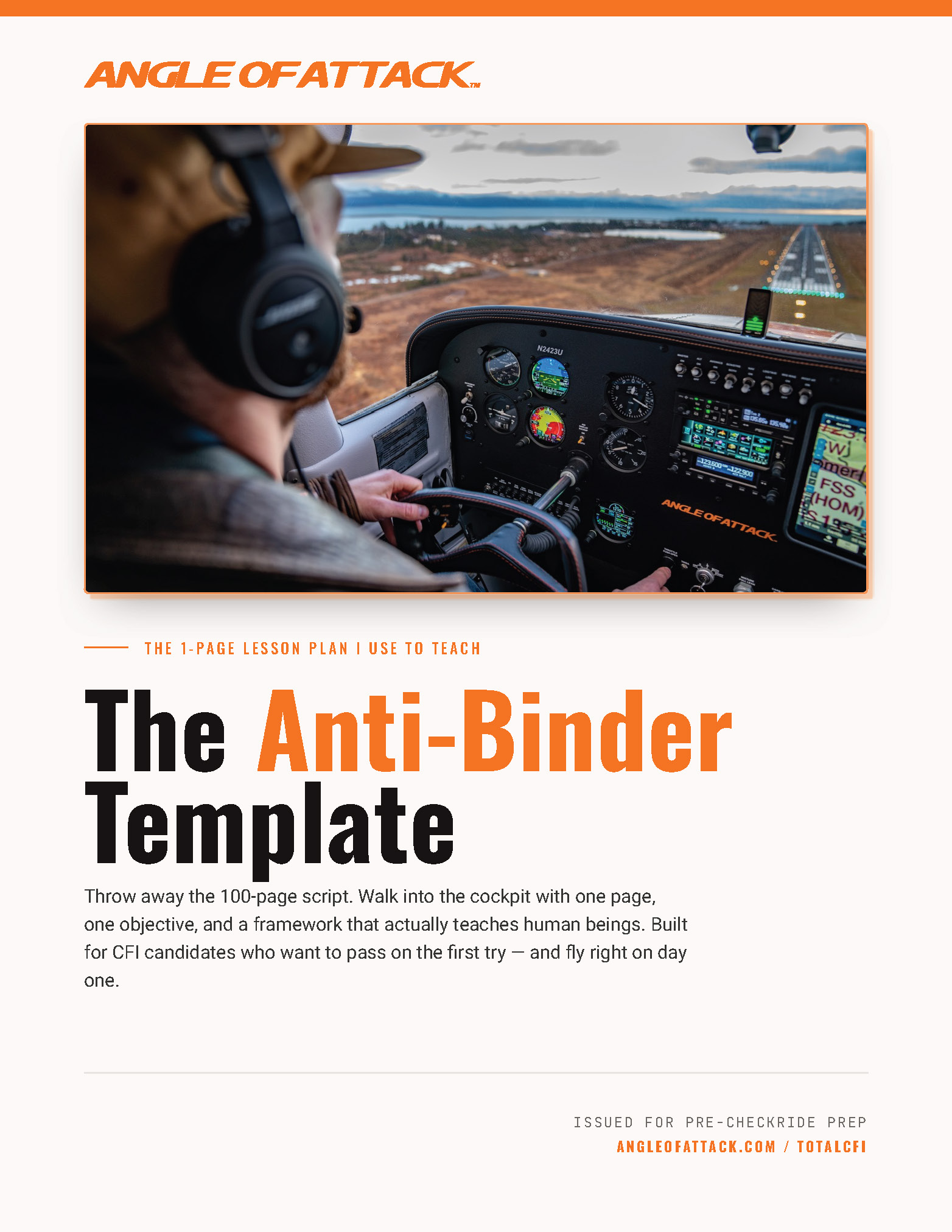
Get my Anti-Binder One-Page Lesson Plan Template free — the lesson plan tool I built for CFI candidates who want to be ready Day 1.
Get the Anti-Binder Template Free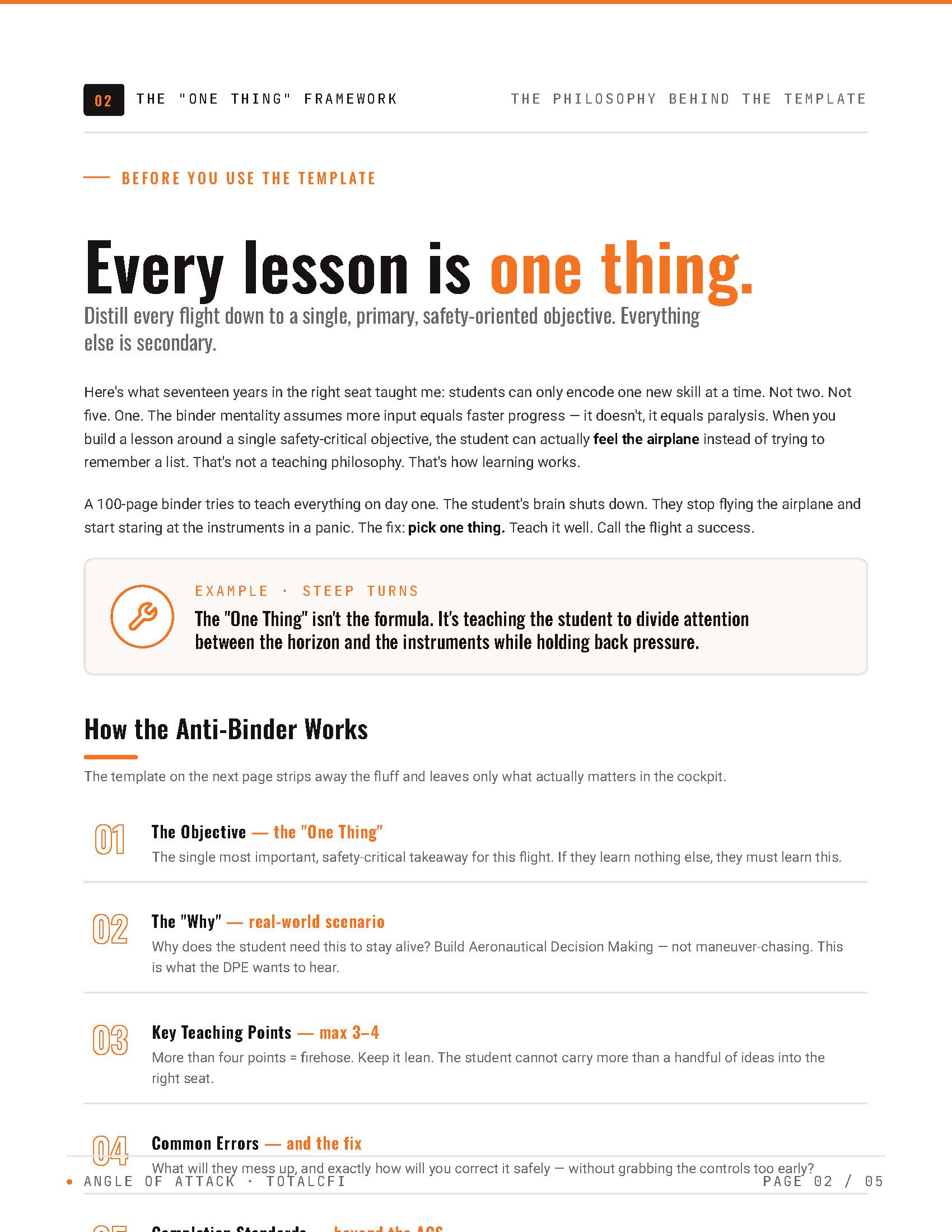
WHAT'S IN THIS GUIDE
- 1What Does the CFI Checkride Actually Test?
- 2Why This Checkride Feels So Different From Every Other One
- 3The Four Things Examiners Actually Score For
- 4What "Teaching a Maneuver" Looks Like in the Airplane
- 5What "Teaching an Oral Question" Looks Like at the Table
- 6How Is the CFI Checkride Different From the Commercial Checkride?
- 7Does the Examiner Expect Perfect Flying?
- 8What's the Most Common Reason Candidates Fail?
- 9Do DPEs or FAA Inspectors Give the CFI Checkride?
- 10How to Practice This Before Your Checkride
- 11Frequently Asked Questions
What Does the CFI Checkride Actually Test?

Your teaching. Not your flying.
That’s the short version, and it’s also the receipt. 14 CFR 61.183 lays out who’s eligible for a flight instructor certificate — you’ve already proven you can fly because you hold a commercial certificate. The CFI checkride exists to prove the other half: that you can transfer what you know to someone else. The current Airman Certification Standards, FAA-S-ACS-25, released March 30, 2024 and effective May 31, 2024, is even more explicit. The evaluator standard for skill tasks reads: the applicant must “simultaneously demonstrate and explain.” Demonstrate and explain. At the same time. Out loud. While the airplane is moving.
That single phrase is the entire test in seven words.
A quick correction on something you’ll see in older guides: the CFI Airplane ACS has 14 Areas of Operation, not eight. The eight-Area count belonged to the old PTS (FAA-S-8081-6D with changes 1-6), which the ACS replaced. If a study source still says “eight Areas,” it’s pre-2024 and out of date. The 14 Areas are listed in 14 CFR 61.187, from Fundamentals of Instructing through Postflight Procedures.
That shift, examiner-to-student, is what the ACS is designed to provoke. It’s not in the regulation as the word “role-play,” but it’s in the operational language of every Task in the document. Once you see it, you can’t unsee it.
Why This Checkride Feels So Different From Every Other One

Every checkride before this one tested your flying. This one tests your teaching. That’s the flip — and that’s why the CFI checkride feels so disorienting even for sharp candidates who’ve already passed three or four practical tests.
Think about what your last 250 hours have trained you to do. Demonstrate proficiency. Hit the tolerance. Stay inside the box on the ACS. Show the examiner you can fly the airplane. You’re conditioned, by reflex, to walk into a checkride and perform. Then on Day One of the CFI prep you’re told to do something different: show the examiner you can transfer the skill. That’s a fundamentally different job, and your nervous system doesn’t know that yet.
This is the reason candidates who can fly lazy eights to ATP standards still fail the CFI checkride. They fly the maneuver beautifully and then go quiet. They don’t narrate. They don’t teach. They don’t catch the simulated student error the DPE just made because they’re focused on their own airspeed. Their flying is fine. The role is the problem.
The candidates who walk in calm are the ones who already made the shift internally. They stopped thinking of themselves as a commercial pilot taking another test, and started thinking of themselves as a teacher being observed. That’s the unlock. It sounds simple. It is simple. But the candidates who skip it are the same candidates who get a Notice of Disapproval naming a teaching observable.
The Day-one ready CFI isn’t the one who flies the best. It’s the one who teaches the best. The CFI checkride is the FAA’s way of verifying that the shift has happened before they let you sign a logbook endorsement.
The Four Things Examiners Actually Score For

“Teach better” is everywhere in CFI prep advice. Nobody tells you what “teach better” actually looks like to the evaluator across the table. Here are the four observable behaviors I’ve watched DPEs score against — at the table, in the airplane, in every kind of Task in the ACS.
-
Clarity. Can you explain a complex concept in language a 40-hour student would actually understand? Jargon you’d use with another CFI is the wrong altitude here. You have to drop down to the student’s level without sounding like you’re talking down to them. The candidates who default to FAR-speak or AIM-speak under pressure lose this one fast.
-
Sequence. Do you teach in an order a real student can follow? Most candidates know all the parts. The examiner is watching whether you can put them in the right order: brief → demonstrate while narrating → hand the controls → coach in real time → debrief. Sequence is the single most-skipped observable I see. Candidates jump from “here’s the maneuver” to “fly it” without the bridge.
-
Error recognition. When the role-play student — that’s the examiner — makes a deliberate mistake, do you catch it fast and accurately? They’ll drift in a steep turn. They’ll call the wrong frequency at an uncontrolled field. They’ll misidentify the cloud-clearance rule in Class E below 10,000. Slow recognition is a teaching failure even if the maneuver still works out. You can’t teach what you didn’t see.
-
Response. When you catch the error, what do you do? The trap is taking the controls. The right move is almost always verbal first — name the error, prompt the correction, let the “student” try again. Controls only if safety demands it. The candidates who fail this observable are the ones who solved their own anxiety by flying the airplane instead of teaching the student.
The four words are your scorecard: clarity, sequence, error recognition, response. Memorize them. They are the entire rubric, every Area of Operation, every Task. Whether you’re at the table answering a regulatory question or in the airplane debriefing a simulated stall, the examiner is asking the same four questions about your behavior.
The FAA’s Aviation Instructor’s Handbook (FAA-H-8083-9B), Chapter 6 (“Assessment”), frames this in academic language as authentic assessment versus traditional assessment. The CFI checkride is authentic assessment. You’re being evaluated on the behavior you’ll exhibit on Day One in front of your first paying student, not on whether you can fill in the right multiple-choice bubble.
What “Teaching a Maneuver” Looks Like in the Airplane

This is the section most candidates need most. Here’s what teaching a maneuver looks like in the airplane, broken into the right sequence and the wrong one.
The wrong way (and I see this constantly): the candidate flies the maneuver, narrates after, asks “any questions?” That’s a demo, not a teaching evolution. The DPE just watched you do exactly what you did on your commercial checkride. They scored you a teaching observable, not a flying one. You missed the test.
The right way is a five-step loop:
- Brief. Before any movement, the maneuver gets briefed on the ground or in cruise. Objective. Completion standards (the actual ACS numbers — bank angle, altitude tolerance, airspeed range). Common errors. Why this maneuver matters to the student’s progression.
- Demonstrate while narrating. This is the “simultaneously demonstrate and explain” language straight out of FAA-S-ACS-25. You fly the maneuver and you teach the maneuver at the same time. Out loud. Power setting, pitch attitude, visual cue, what you’re feeling in the controls, what to watch for next.
- Hand the controls. “Your airplane” — verbal, clear, with a positive transfer. Now the role-play student flies it.
- Coach in real time. As the simulated student flies, you coach without taking over. Verbal corrections. Prompts. “Watch your nose, you’re climbing.” “Bank’s shallowing, add aileron.” Catch the error, name it, prompt the fix.
- Debrief. After the maneuver, you debrief what happened. What was good. What needs work. What you’d do differently next time. Tied back to the brief.
That loop — brief, demonstrate while narrating, hand the controls, coach, debrief — is the operational answer to “what does teaching a maneuver look like?” It’s also the structure I teach in TotalCFI Lesson 3.4 on scenario-based instruction. Every required maneuver fits the same loop: steep turns, slow flight, stalls, lazy eights, chandelles, ground reference, emergency operations. The maneuver changes. The loop doesn’t.
Take a steep turn as a worked example. The candidate who flies the steep turn says: “Watch this.” Rolls in, holds 45 degrees of bank, holds altitude, rolls out on heading. Says: “There you go.” That’s a flight demonstration. It is not teaching.
The candidate who teaches the steep turn says: “Okay, steep turn to the left, 45 degrees bank, holding altitude within 100 feet, rolling out on the heading we started on. The visual cue is the cowling against the horizon at this bank angle — I’m going to point it out as we roll in. Common error students make is letting the nose drop as bank steepens; the back-pressure increases more than you’d expect. Watch with me.” Rolls in. “Bank’s 45, back-pressure on, nose is holding. Now: your airplane. Pick a point on the horizon as your reference.” That’s teaching the steep turn. Same maneuver, same airplane, same tolerance. Completely different evaluation.
What “Teaching an Oral Question” Looks Like at the Table

The oral works exactly the same way. Every question the examiner asks is a stealth teaching demonstration. The wrong way is to answer the question with a regulatory paragraph. The right way is to assume the examiner is a 40-hour student who has never heard of this regulation, and teach it.
Take a real one: “What’s the cloud clearance in Class E below 10,000 feet, day VFR?”
The test-taker answer sounds like this: “Three statute miles visibility, 500 feet below, 1,000 feet above, 2,000 feet horizontal.” Accurate. Complete. Defensible. Also a fail for teaching observable — that’s regurgitation. The candidate just recited 14 CFR 91.155 from memory and called it a day.
The teaching answer sounds like this: “Class E below 10,000 is the chunk of airspace where most of our cross-countries happen. Day VFR you need three statute miles flight visibility — meaning what you can actually see from the cockpit, not what’s reported at the field. For cloud clearance, the rule we use is 500-1-2: 500 below the clouds, 1,000 above, 2,000 horizontal. The reason for the gap is reaction time. At 250 knots true closure, 2,000 feet horizontal gives you about 2.4 seconds to see and avoid. Above 10,000 the rule gets stricter because closure speeds increase. Want me to draw the picture?”
Same answer. Completely different evaluation.
Notice what the teaching version did. It set context (where this airspace lives). It used plain language and the regulation (so the student gets both the rule and the why). It introduced a mnemonic the student can carry forward. It tied the rule to a physical reason (closure speed and reaction time). And it ended with a teaching offer (‘want me to draw the picture?’) that signals you’re not done, you’re checking comprehension.
This is the FAA’s Levels of Learning at work, from FAA-H-8083-9B Chapter 2. Rote is reciting the rule. Understanding is explaining the why. Application is using the rule in a scenario. Correlation is connecting it to other rules and to the actual flying environment. The CFI checkride is the FAA’s verification that you can teach at Correlation, not just recite at Rote. If your oral answers stop at Rote, you’re showing the examiner you can’t teach. Every oral question is the same test, wearing different clothes.
How Is the CFI Checkride Different From the Commercial Checkride?
| Dimension | Commercial Checkride | CFI Checkride |
|---|---|---|
| What's tested | Your flying skill | Your ability to teach flying skill |
| Examiner's role | Observer evaluating proficiency | Role-playing student evaluating instruction |
| Maneuver standard | Within ACS tolerances | Within ACS tolerances and teach to the standard while you fly it |
| Oral focus | What do you know? | Can you explain what you know to a 40-hour student? |
| Pass mindset | "Don't bust tolerance" | "Make the student understand" |
| Typical duration | 4-6 hours total | 6-10 hours total (4-6 oral + 1.5-2 flight) |
If you walk into the CFI checkride with the commercial mindset (‘don’t bust tolerance, show I can fly’), you’re aimed at the wrong target. The tolerance still matters. You still have to fly within ACS standards. But the teaching is the test. Hit the tolerance while you’re teaching the tolerance. That’s the standard.
This is the same point C1, the full CFI checkride guide, opens with. But it’s worth repeating in every cluster article, because it’s the single most consequential mindset shift in the entire CFI training pipeline. Get it wrong and you fail. Get it right and you walk in calm.
Does the Examiner Expect Perfect Flying?

No. They expect teachable flying. There’s a difference.
If you bust altitude by 80 feet on a steep turn, the commercial-checkride question is “did the candidate exceed the tolerance?” The CFI-checkride question is “what does the candidate tell their student about why that happened, and how to prevent it?” Same event. Completely different evaluation.
I’ve watched candidates fly maneuvers that were technically inside tolerance and still fail for not teaching them. I’ve also watched candidates bust a tolerance by a small margin and pass because they turned the error into a teaching moment. The DPE is looking for evidence that when you’re in the right seat at 9 AM next Tuesday with a real student, and your student makes a mistake, you can teach through it without panic.
The trick: when something goes wrong on your checkride, don’t apologize. Teach. “Notice I drifted high through the rollout there. That’s a common error. The cause is usually shallowing the bank before the pitch is set. Watch how I fix it.” Now you’ve taken an imperfect maneuver and turned it into a teachable moment. The examiner just got a free demonstration of exactly the skill they’re trying to measure.
That’s the “License to learn” principle showing up in real time. The certificate doesn’t mean you fly perfectly. It means you can keep teaching when flying isn’t perfect. In real-world instructing, that’s most of the time.
What’s the Most Common Reason Candidates Fail?

The patterns are remarkably consistent. The Notice of Disapproval, issued under 14 CFR 61.43, names the specific Area of Operation and Task failed. Across hundreds of failures I’ve seen documented, the named failures almost always fall into three buckets:
- Demonstrating their own skill instead of teaching the student. The candidate flies the maneuver beautifully. They never narrate. They never debrief. They never catch the simulated student error. The maneuver was inside tolerance. The teaching was absent. Failure named under whichever flight Area was being evaluated.
- Answering oral questions as a test-taker. The candidate gives clean regulatory citations to every question. They never teach a concept. They never check for understanding. The oral never crosses into Application or Correlation. Failure named usually in Area II (Technical Subject Areas) or Area III (Preflight Preparation).
- Taking the controls when the simulated student needs to fail forward. The candidate sees the role-play student about to bust an altitude or miss a checklist item. Instead of verbal correction, they take the airplane. They solved their own anxiety. They prevented the teachable moment. Failure named in lesson control or in the specific maneuver Task.
The bigger pattern: the Notice of Disapproval almost always names a teaching observable, not a flying tolerance. That’s worth sitting with. The DPE who fails you writes “you didn’t teach the lazy eight,” not “you couldn’t fly a lazy eight.”
The data backs this up. The 2025 CFI initial failure rate hit 26.3% (a four-year high) per FAA practical test data summarized by Jason Blair, an industry DPE who tracks the numbers. Industry-reported first-time pass rate sits between 60 and 70 percent. The failures are not random. They cluster in the teaching observables I just described. The full pass-rate breakdown is in C3, the CFI checkride pass rate article.
If you’ve already busted a CFI checkride, the failed CFI checkride recovery article walks through what comes next. The single retest path is forgiving — most candidates pass on the retest after fixing exactly the observable the Notice named.
Do DPEs or FAA Inspectors Give the CFI Checkride?

Mostly DPEs now. Some FSDOs still administer where DPEs are scarce.
The story is recent. Up until 2018, initial CFI practical tests typically had to route through the local FAA Flight Standards District Office — the FSDO — which created backlogs in busy markets. The October 2018 FAA policy update changed that, removing the geographic restrictions on Designated Pilot Examiners and explicitly authorizing DPEs to administer initial CFI checkrides. Per AOPA’s reporting at the time, the policy raised the daily test cap from two to three and let applicants schedule directly with a DPE without FSDO involvement.
The result: most initial CFI checkrides today are DPE-administered. Some FSDO inspectors still give them in markets where DPE coverage is thin, and the experience differs only at the margins — same ACS, same standards, same role-play frame. The DPE-vs-inspector question matters far less than candidates think it does.
The DPE corps itself is stretched. Per General Aviation News reporting in October 2024, roughly 350 of the 935 authorized DPEs nationally administer 75 percent of all practical tests, and scheduling backlogs of four to five months are common in busy regions. That’s a logistics problem, not a content problem. The test is the test wherever you take it.
The October 2024 FAA final rule — published in the Federal Register at 89 FR 80020, effective December 1, 2024 — removed the expiration date from CFI certificates and added two new pathways for instructors to qualify as trainers of initial CFI applicants. That changes who can sign you off on the ground side. It doesn’t change what the examiner is testing in the practical.
How to Practice This Before Your Checkride

The reframe is the unlock. Practicing the reframe is the work. Three drills I give every candidate in the final month before their initial:
-
Teach a non-pilot friend a single maneuver tonight. Pick one — steep turns, slow flight, anything. Sit at the kitchen table. Walk them through it like they’ve never been in a Cessna. Use a chair as the airplane if you have to. The moment they ask a question you didn’t anticipate, you’ve learned something about your teaching that no flight will reveal.
-
Record yourself explaining a regulation to a phone camera. Pick one regulation: 91.155, 61.89, 91.103, anything. Set the phone on a counter. Explain the rule to it as if you’re explaining to a student. Watch it back. If you sound like a textbook, you have work to do. If you sound like a teacher, you’re closer to Day-one ready than you think.
-
Find a fellow CFI candidate and trade students. They teach you. You teach them. The honest feedback from a peer who’s also in the trenches is worth more than a senior CFI giving notes from above, because the peer can tell you exactly what wasn’t clear. Most checkride failures could be prevented by 10 hours of peer practice in the last two weeks.
Reframing the checkride as a teaching demonstration is the single biggest unlock for most CFI candidates. It’s the centerpiece of TotalCFI Lesson 2.3 (the lesson this article is built on), and it’s why the candidates who internalize it walk in calm. The full 30-day prep plan that surrounds these drills is in C4 — the CFI checkride prep guide. For the deeper oral preparation, C2 — common CFI oral exam questions walks through the question bank itself.
If you haven’t passed the FOI and FIA written tests yet, those come first — the FOI study guide is the right starting point for FOI, and the rest of the cluster covers everything around it. And if you’re still asking how long becoming a CFI takes or how CFI compares to CFII, those articles are sized for those exact questions.
Frequently Asked Questions
How long is the CFI oral exam? Typically 4-6 hours. Some examiners run longer — 4-8 hours is within normal range. The FAA doesn’t define a minimum or maximum duration; the standard is whether every required Area of Operation has been adequately tested. Plan for a full day at the table.
How long is the flight portion? Typically 1.5-2.0 hours. Combined with the oral, the entire CFI practical runs 6-10 hours — the longest practical test in the FAA system. Bring water, bring snacks, and treat it like an endurance event.
How many lesson plans do I need? Industry norm is 30-40 lesson plans covering every Task in the ACS. FAA-S-ACS-25 explicitly allows previously-developed lesson plans and computer-generated plans — you don’t have to write them from scratch. The Anti-Binder Template at the top of this article is the format I use; the lesson plan article walks through the structure.
Can I fail just one section? Failing any Area of Operation means you fail the practical test — per 14 CFR 61.43. But credit is preserved for the Areas you already passed. Bring the original Notice of Disapproval to your retest and the examiner only re-tests the failed Area. Most candidates pass the retest because they know exactly what to fix.
Is the CFI checkride pass rate really that low? The 2025 FAA data shows a 26.3% failure rate on initial CFI practical tests, a four-year high. Industry-reported first-time pass rate sits around 60-70 percent (the FAA stats don’t separate first-time from retake). It’s the lowest first-time pass rate of any standard pilot certificate. The reason is the role flip, not the difficulty. The full breakdown is in C3.
What if my DPE seems hostile? They’re acting. Some DPEs role-play a frustrated student. Some role-play a nervous primary student. Some role-play an over-confident transitioning private pilot. None of it is personal. Take the role-play seriously, treat the examiner as the student they’re pretending to be, and the test gets easier, not harder. Hostility in the role-play is information about your future student, not a verdict on you.
If the CFI checkride is keeping you up at night, you're prepping for the wrong thing.
TotalCFI teaches you to walk into the oral as a teacher, not a test-taker — the reframe most candidates only figure out after they've already failed once.

The CFI checkride is a teaching demonstration with one audience member who happens to be paid to evaluate it — not an interrogation. The Areas of Operation, the maneuvers, the oral questions — they’re all the same examiner question wearing different clothes: can you teach? The candidates who pass already think of themselves as teachers. They treat the right seat as a classroom. They walk in calm because they’ve made the mental shift before they ever sat down at the table.