Failed Your CFI Checkride? Here’s Exactly What to Do Next (And How to Come Back Stronger)

If you just walked out of a CFI checkride with a Notice of Disapproval in your hand, the first thing I want you to know is this: it’s okay. You’re not the first CFI candidate to fail your initial, and you won’t be the last. The 2025 FAA Civil Airmen Statistics put the CFI initial pass rate at 73.7%. Almost one in four candidates is exactly where you are right now. The DPE didn’t say you can’t be a CFI. They said not yet. Here’s what comes next.
I’m Chris Palmer, two-time Master Aviation Educator, Gold Seal CFI, founder of Angle of Attack. I’ve been in aviation education since 2006, and a CFI since 2017. I’ve sat with candidates the night they failed, and I’ve sat with them again the morning they passed the retest. Both nights matter. Tonight, we talk about the work between them. (If you want the full lay of the land on the CFI ride itself, the CFI checkride pillar guide is the parent of this article.)
- The 2025 FAA Civil Airmen Statistics show a 73.7% CFI initial pass rate. Almost 1 in 4 CFI candidates retest. You’re in normal company.
- A failure is documented on FAA Form 8060-5, Notice of Disapproval. Under 14 CFR 61.43(f), you have 60 days to retest only the failed Areas of Operation. After 60 days, you retake the entire test.
- Per 14 CFR 61.49, the retest requires additional training and a logbook endorsement from an authorized instructor. The sample endorsement is in AC 61-65K, Appendix A.77.
- Most CFI initial failures happen on the oral, not the flight. Almost every failure traces to one of four diagnostic patterns we’ll name in this article.
- A single CFI initial failure is widely regarded as the most forgivable item on an airline-hiring record. Pattern beats presence. Honesty in the interview beats concealment every time.
Walking into your first lesson with a 50-page binder won't help you.
Get my Anti-Binder One-Page Lesson Plan Template free — the lesson plan tool I built for CFI candidates who want to be ready Day 1.
Get the Anti-Binder Template Free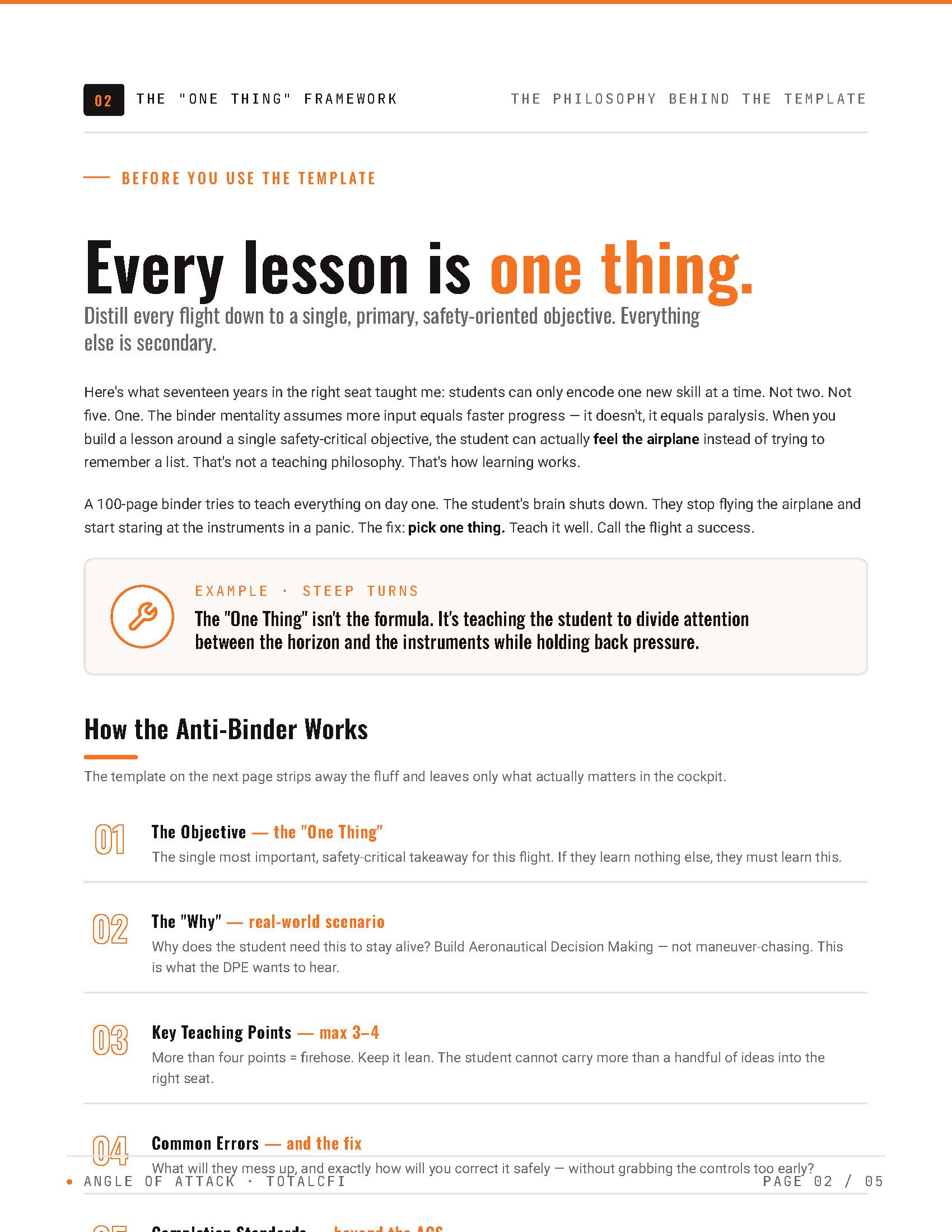
WHAT'S IN THIS GUIDE
- 1First, Take a Breath. You’re Not Alone.
- 2What Happens If You Fail Your CFI Checkride?
- 3Can You Retake the CFI Checkride?
- 4How Long Do You Have to Retake the CFI Checkride?
- 5How Much Does It Cost to Retake a CFI Checkride?
- 6What’s the Most Common Reason Candidates Fail?
- 7How to Read Your Notice of Disapproval
- 8How to Prepare for the CFI Retest (The Reset Framework)
- 9Does a Failed CFI Checkride Affect Your Career?
- 10When You’re Ready, Go Again
- 11Frequently Asked Questions
First, Take a Breath. You’re Not Alone.

Here’s what the data actually says. The 2025 FAA Civil Airmen Statistics show the CFI initial at 73.7% pass, 26.3% fail. That’s a four-year peak — but still below the pre-2018 historical norm of roughly 30%. DPEs ran 73.7%, FAA inspectors ran 77.9%. As of 2025, the CFI initial is once again the most-failed pilot certificate practical test in the country, overtaking the Private Pilot ticket that held that spot from 2022 to 2024.
What that means for you: one in four candidates sits in this exact moment. Not a small group. Not the exceptions. The DPE’s bar is high on purpose. They’re about to give you the authority to sign a stranger’s pilot certificate. The standard is appropriate. (For the full pass rate trend across the last decade, see the CFI checkride pass rate breakdown.)
You’re in good company in the history books. According to AOPA’s Flight Training magazine (November 2013), Barry Schiff, a TWA captain for 34 years, failed his CFI checkride at 18. He earned his ATP at 21. Most really good CFIs I know busted their initial. That’s a pattern, not folk wisdom.
Take the breath. Then we’ll go to work.
What Happens If You Fail Your CFI Checkride?

When you don’t meet the Airman Certification Standards on one or more of the Areas of Operation listed in 14 CFR 61.187(b), the DPE issues FAA Form 8060-5, Notice of Disapproval of Application. It lists the specific tasks and Areas of Operation that weren’t satisfactorily completed. The form used to be printed on salmon-colored paper; old-timers still call it the “pink slip.” Today it’s usually a digital PDF or a white printout.
§61.187(b) is the regulation that lists the Areas of Operation for every flight instructor rating, by aircraft category. Eligibility — age, certificates held, experience — lives in 61.183. Two different regs, two different jobs.
14 CFR 61.43(c) states that if you fail any Area of Operation, you fail the practical test. One missed AOO and the whole ride is a disapproval. The DPE isn’t grading you as a person. They’re grading specific Areas of Operation against the Flight Instructor ACS (FAA-S-ACS-25), and one of them didn’t meet the standard on the day.
One distinction to know: a Notice of Disapproval (you failed an AOO) is different from a Letter of Discontinuance (the test was stopped before all AOOs were scored, usually weather or an aircraft squawk). Both trigger the same 60-day clock under 14 CFR 61.43(f). A discontinuance is a pause, not a failure.
(Regulatory aside: 61.43(f) opens with “If a practical test is discontinued” — but subsection (f)(2) explicitly permits either the Notice of Disapproval or the Letter of Discontinuance to satisfy the credit-retention requirement. Both clocks are 60 days from the document date.)
The Notice of Disapproval doesn’t get attached to your logbook the way an endorsement does. It’s an FAA record, filed with your IACRA application. Your CFI candidate flight record stays intact.
Can You Retake the CFI Checkride?
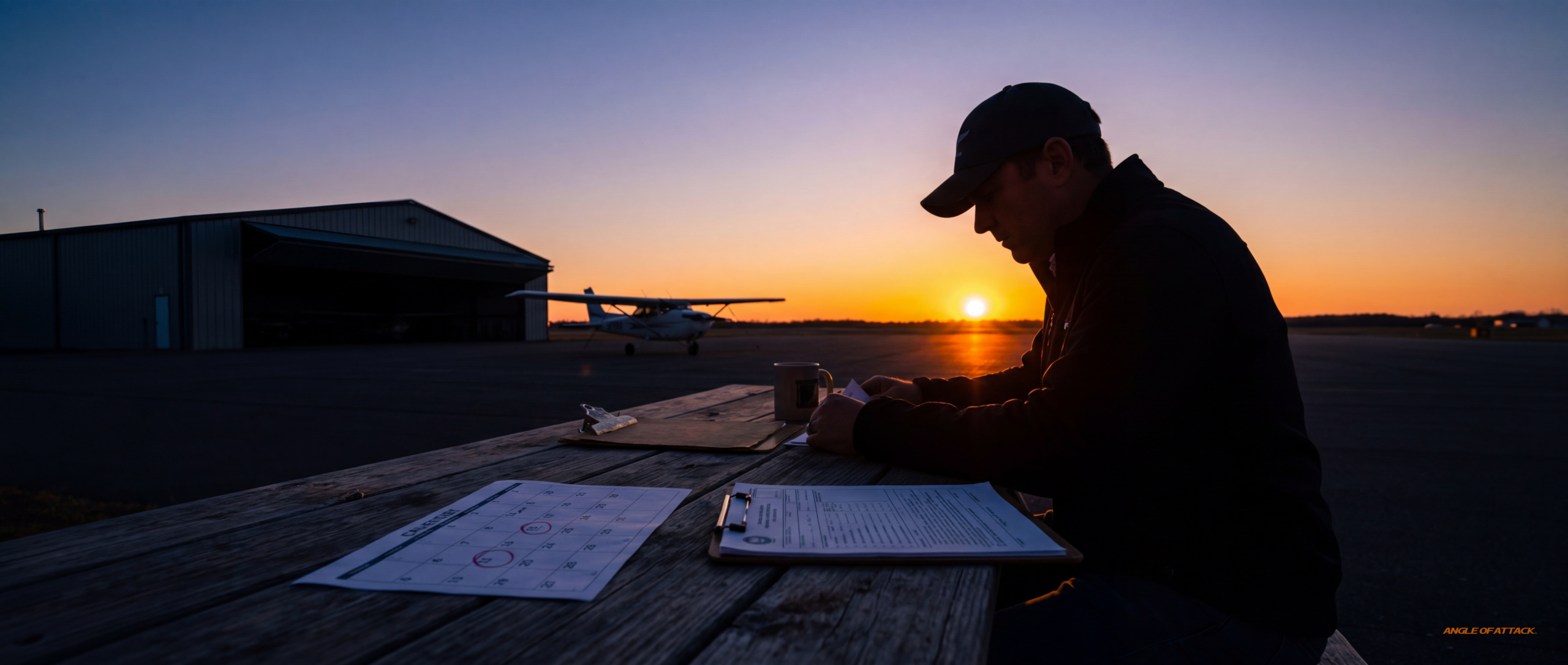
Yes. As many times as it takes. There’s no FAA-mandated cap on attempts and no mandatory waiting period. 14 CFR 61.49 is the regulation that governs retest after failure, and it’s short enough to quote:
“An applicant for a knowledge or practical test who fails that test may reapply for the test only after the applicant has received: (1) The necessary training from an authorized instructor who has determined that the applicant is proficient to pass the test; and (2) An endorsement from an authorized instructor who gave the applicant the additional training.”
Two requirements before you can rebook: additional training from an authorized CFI (yours or any), and a logbook endorsement attesting to that retraining. The endorsement language is in Advisory Circular AC 61-65K, Appendix A, endorsement A.77, page A-21. Verbatim:
“I certify that [First name, MI, Last name] has received the additional (flight and/or ground, as appropriate) training as required by § 61.49. I have determined that he/she is prepared for the [name of] knowledge/practical test.”
Show that text to your CFI when you go back for retraining. They’ve written it before — but having the page reference handy makes it a 30-second logbook stamp instead of a 5-minute “let me dig out the AC” exercise.
There’s one CFI-specific subclause in 61.49(b) worth knowing. If your failure involved stall awareness, spin entry, spins, or spin recovery, your retest must include all of those tasks again, and you must bring an aircraft certificated for spins. Most CFI candidates bring a Cessna 152 Aerobat, a Citabria, or a Decathlon to satisfy that. Talk to your CFI and your DPE about the right airplane.
One more thing worth knowing: you can switch DPEs. The Notice of Disapproval is portable. If you and your original examiner have a personality mismatch, or if the post-test debrief left you with the sense the next ride won’t go better with the same person, find another DPE. The retest doesn’t have to happen with the examiner who failed you.
How Long Do You Have to Retake the CFI Checkride?

You have 60 days from the date of the Notice of Disapproval to retest only the failed Areas of Operation. This is codified, not custom, in 14 CFR 61.43(f) and reinforced for DPEs and Inspectors in FAA Order 8900.1, Volume 5, Chapter 1, Section 4.
If you fail one AOO and pass everything else, you get credit for the AOOs you passed, as long as you complete the remaining sections within 60 days, present the Notice of Disapproval, obtain the required endorsements, and submit a completed application. That’s a partial retest. Faster and cheaper than a full retake.
After 60 days, credit expires. You retake the entire practical test from the top. That’s why scheduling matters. Most candidates retest 1 to 3 weeks after the Notice. Enough time for focused retraining, not so much that the 60-day clock pressures the work.
The schedule is about being ready. The honest question is “what specifically broke last time, and is the new behavior real enough that I’d bet my certificate on it.” If yes, schedule. If no, more reps.
How Much Does It Cost to Retake a CFI Checkride?

Costs vary by DPE, by aircraft, by retraining hours. The vendor-reported industry ranges:
- Partial retest DPE fee, same DPE (failed AOOs only): typically $300 to $500
- Partial retest DPE fee, different DPE: many examiners charge their full initial CFI fee ($750 to $1,200) regardless of how few AOOs they’re scoring, because they still set up the whole test
- Full retake DPE fee (after 60-day expiration, or new DPE charging full fee): typically $700 to $1,200
- Aircraft rental for retest: 1 to 3 hours of dual retraining plus 1 to 2 hours of retest flight time
- Retraining instructor time: highly variable, typically 5 to 15 hours depending on which of the four diagnostic patterns hit
Typical total cost band: $400 to $1,500 depending on partial-versus-full, your DPE, your aircraft rate, and retraining hours. Some DPEs don’t charge for retests at all; that’s examiner discretion, not regulation. (For the broader CFI timeline including a typical retest cycle, see how long it takes to become a CFI.)
Cost isn’t the gating problem for most candidates. Time is. Every week between the fail and the retest is a week your CFI certificate isn’t earning. Get the retraining right, then go. Fast and right beats slow and over-prepared.
This is why TotalCFI ships with a Day-One Ready Guarantee. The Guarantee is built around exactly this moment: the candidate who failed once and needs the prep to actually fix what broke.
What’s the Most Common Reason Candidates Fail?

Here’s the first thing nobody tells you: most CFI initial failures don’t happen in the airplane. They happen at the table. DPEs end most CFI initial rides during the oral, usually on systems knowledge, aerodynamic explanation, endorsements, lesson plan adequacy, or cross-country planning. The flight portion gets fewer fails than candidates assume. If you can fly your maneuvers from the right seat, the oral is where the ride lives or dies. (For the question bank that gets asked most, see the CFI oral exam questions guide.)
In my experience, almost every CFI initial failure traces to one of four diagnostic patterns. The Notice of Disapproval will name something: “failed to provide instruction during maneuver,” “lesson plan inflexible,” “inadequate knowledge of aircraft systems.” Translate the language. You’ll see one of these four:
1. Demonstration Mode. You flew the maneuver flawlessly, but you didn’t teach it. Silent execution. No narration. No anchor to “what would your student see at this moment, and what would they need to know.” A great pilot doing a maneuver next to an examiner is still a pilot taking a test. The CFI ride wants a teacher. The fix: practice every maneuver with continuous narration. Record yourself. If the audio works without the video, you’re teaching. If it only works with the video, you’re demonstrating.
2. Lesson Plan Rigidity. You walked in with a binder. You read from the binder. When the examiner played the role of a confused student and asked “what if I do X instead?” you flipped pages. You were using the lesson plan as a script. The fix: build the lesson plan once, then teach it 10 times to a non-pilot from memory. The binder is a backup. Your teaching shouldn’t depend on it. (We go deeper on this in the CFI lesson plan template.)
3. Systems / Aerodynamics Gap. You couldn’t explain the why. Why does the airplane turn left on the takeoff roll? Why does an inside spin recover the way it does? What does “IO-360” actually designate? What do the color arcs on the airspeed indicator mean and what does each one bound? You memorized answers without understanding concepts. The fix: stop memorizing. Start drawing. If you can sketch P-factor on a napkin in 30 seconds, you understand P-factor. If you can’t, you don’t, and the DPE will find that gap in two questions. (For the FOI side of the same gap, see the FOI study guide.)
4. Lost the Frame. The examiner played a struggling student. You slipped out of instructor mode. Got defensive. Answered as a test-taker. Treated the role-play as adversarial, or stopped controlling the lesson when the “student” pushed back. The candidate became the student again. The fix: the examiner is always your student during a CFI ride. Always. Even when they’re being a jerk on purpose. Your job: stay in the chair, stay calm, teach through it. Calm is a skill. Train it.
Look at your Notice of Disapproval. Match the DPE’s notes to one of these four. Almost every initial fail names one dominant pattern, sometimes a second. Naming the pattern is half the work of fixing it. (For the deep-dive on the reframe the DPE is testing, see what the examiner is really testing.)
How to Read Your Notice of Disapproval

The Notice of Disapproval is a one-page form. Six fields matter for your retest plan.
Applicant Information. Your name, your IACRA Federal Tracking Number (FTN), the certificate you applied for, the date of the test.
Examiner Information. DPE’s name and designation number. You’ll need it on retest paperwork.
Aircraft Used. Make, model, N-number. If you’re switching aircraft for the retest (e.g., picking up a spin-certified airplane for 61.49(b) tasks), this matters.
Areas of Operation Not Satisfactorily Completed. This is the retest map. Within 60 days, those are the only AOOs you retest. Everything else retains credit. Each AOO maps to a specific section of the Flight Instructor ACS. Look up each one. Read the standard. Know what the bar actually is.
Examiner Notes / Remarks. Gold. The DPE typically writes a paragraph or two on what specifically went wrong. This is where you find the diagnostic pattern. Read it line by line. The DPE isn’t being subtle.
Signature and Date. Establishes the 60-day clock under 61.43(f). 60 calendar days from there is your partial-retest window.
What the Notice of Disapproval does not say: it does not say you’re not cut out for this. It does not say you’ll be a bad CFI. It says you didn’t meet the standard on these specific tasks on this specific day. Those are different sentences. Read the right one.
How to Prepare for the CFI Retest (The Reset Framework)

Here’s the most common mistake candidates make on retest prep: they re-prep the same way they did the first time. Same flashcards. Same maneuver drills. Same notes. The retest fail rate goes up when the prep didn’t change, because the teaching didn’t change. The way you taught the maneuvers was the problem, not the maneuvers themselves.
The reset framework, four steps:
Step 1: Read the Notice of Disapproval honestly. Which of the four diagnostic patterns fits? Not the one you wish fit. The one that actually fits. If you have to ask “is it pattern 1 or pattern 3?”, show the Notice to a CFI who wasn’t on the ride. They’ll tell you in five minutes.
Step 2: Retrain the failure pattern, not just the failed maneuver. If you failed for Demonstration Mode on slow flight, the fix is narrating every maneuver until you can’t stop narrating, not more slow flight reps. If you failed for Systems Gap on the IO-360, the fix is drawing the engine on a whiteboard until you can teach it cold, not memorizing more facts about the IO-360.
Step 3: Teach to a non-pilot. Find a friend, a partner, your barista. Teach them the failed material from your written lesson plan. If they can summarize the concept back to you in their own words, you’re teaching. If they look confused and you find yourself saying “well, you don’t need to understand it to fly it,” you’re still in demonstration mode. Iterate until the non-pilot gets it.
Step 4: Get the retraining endorsement. AC 61-65K Appendix A.77. Show your CFI the wording above. Your CFI signs your logbook. You’re cleared to schedule the retest.
The candidates who pass the retest on the first try are almost always the ones who changed how they teach, not what they memorize. That’s Lesson 2.3 in the TotalCFI course, and it’s why the Day-One Ready Guarantee exists.
For the broader 30-day prep arc, see the CFI checkride prep plan. Same framework, different starting line.
Does a Failed CFI Checkride Affect Your Career?

The honest answer: yes, airlines see it. And in 95% of cases, it doesn’t matter.
Here’s the mechanism. Under the Pilot Records Improvement Act (PRIA, 1996), now operationalized through the FAA-maintained Pilot Records Database (PRD), airlines query a federal database during hiring. The PRD includes all FAA practical test failures, enforcement actions, accidents, and airline training failures. Your CFI initial fail shows up there.
But here’s the part most candidates don’t hear. The CFI initial is widely regarded as the most forgivable failure on a record. The reason: the CFI initial is the hardest test in your career so far, by design, and a quarter of candidates retest. Airlines know this.
The line is pattern. One CFI initial fail with a clean retest and a clean career after is a story. Multiple training failures across different certificates, or a fail with no honest framing, that’s a signal. The signal is the pattern, not the presence.
The rule for interviews: never hide it. Concealment is disqualifying, far more than the event itself. Take 100% ownership, name what you learned, name the new behavior, move on. Two sentences. Don’t dwell.
Your CFI certificate is the license to learn, and so is every step after it. The airline interview is one more conversation in that same training conversation. Tell the truth. Move on.
When You’re Ready, Go Again

Before you book the retest, ask yourself one honest question. Not “do I want to be done with this.” Not “can I afford another week of waiting.” One question:
Tomorrow morning, can I teach this material to a student, not just pass a test on it?
If the answer is yes, schedule. If the answer is no, more reps. Your honest answer to that question is where you find out if you’re ready. The retest is where you confirm it.
The CFI certificate is different from every other rating you’ve earned. Private and Instrument and Commercial measured your ability to fly. The CFI measures your ability to teach somebody else to fly. That’s a different skill, and it’s the skill that day-one matters. The day after the retest, you’ll have students. Not “students” in the abstract. A specific name on a specific schedule, sitting next to a specific airplane. They don’t care that you passed your checkride. They care whether you can teach them to land. Day-one ready. That’s the bar.
Professionalism is not a certificate — it’s behavior. The candidate who walks into the retest ready to teach tomorrow passes the retest. The candidate who walks in hoping to pass the retest often doesn’t. The reframe is the work. (If the retest is shaking your confidence about being a CFI at all, read how to build confidence as a new CFI.)
If you want the system I built around this, the lesson frameworks, the maneuver scripts, the oral diagnostics, the Day-One Ready Guarantee that backs the prep, that’s what TotalCFI is.
Frequently Asked Questions
What happens if I fail my CFI checkride?
The DPE issues FAA Form 8060-5, Notice of Disapproval, listing the specific Areas of Operation that didn't meet the Airman Certification Standards. Under 14 CFR 61.43(f) you have 60 days to retest only the failed AOOs. Per 14 CFR 61.49, the retest requires additional training and a logbook endorsement from an authorized instructor.
Can I retake the CFI checkride?
Yes. There's no FAA-mandated waiting period or attempt cap. You must complete additional training in the failed areas and obtain a retraining endorsement (AC 61-65K, Appendix A.77) before reapplying. You can also switch DPEs if you choose. The Notice of Disapproval is portable.
How long do I have to retake the CFI checkride?
60 days from the date of the Notice of Disapproval to retest only the failed Areas of Operation per 14 CFR 61.43(f). After 60 days, the credit for previously passed sections expires and you retake the entire practical test.
How much does it cost to retake a CFI checkride?
Vendor-typical ranges: partial retest DPE fee $300 to $500 with the same DPE; a different DPE often charges the full $750 to $1,200 initial fee even for a partial retest; full retake $700 to $1,200; plus 1 to 3 hours of aircraft retraining and 1 to 2 hours of retest flight time. Total typical retest cost band: $400 to $1,500. Some DPEs don't charge for retests at all; that's examiner discretion.
How many times can I fail a CFI checkride?
No FAA limit. As many retest attempts as it takes, each requiring additional training and a retraining endorsement under 14 CFR 61.49. Pattern matters more than count on long-term career records. One fail is a story; a string of fails is a signal.
What is a Notice of Disapproval?
FAA Form 8060-5, issued by the DPE when a candidate fails any Area of Operation on a practical test. Lists the specific tasks not satisfactorily completed. Filed with the IACRA application and queried by airlines through the Pilot Records Database (PRD). Historically printed on salmon paper, hence the "pink slip" nickname.
Does a failed checkride stay on my record?
Yes. Failures are recorded in the FAA Pilot Records Database under PRIA. Airlines see them during hiring. The CFI initial is widely regarded as the most forgivable single failure on a record, especially with an honest framing in the interview and a clean track record afterward.
Do airlines check failed checkrides?
Yes. The Pilot Records Database (PRD) is the federal source airlines query. A single CFI initial fail is rarely disqualifying. Pattern beats presence. The disqualifying behavior is concealment, not the failure itself.
If the CFI checkride is keeping you up at night, you're prepping for the wrong thing.
TotalCFI teaches you to walk into the oral as a teacher, not a test-taker — the reframe most candidates only figure out after they've already failed once.

The DPE issues FAA Form 8060-5, Notice of Disapproval, listing the specific Areas of Operation that didn’t meet the Airman Certification Standards. Under 14 CFR 61.43(f) you have 60 days to retest only the failed AOOs. Per 14 CFR 61.49, the retest requires additional training and a logbook endorsement from an authorized instructor.