What Can a CFI Teach? A Plain-English Guide to Your Privileges as a New Flight Instructor
A Certified Flight Instructor can teach almost every kind of flying a pilot ever does. Student through commercial single-engine, ground school, flight reviews, transition training, endorsements. All of it sits inside three filters: the category and class on your flight instructor certificate, any add-on ratings you’ve earned (CFII for instrument, MEI for multi-engine), and the endorsements you personally hold (tailwheel, complex, high-performance, high-altitude, spin). 14 CFR 61.193 sets the scope; 14 CFR 61.195 sets the limits.
I’m Chris Palmer, Founder and Chief CFI at Angle of Attack, two-time Master Aviation Educator (NAFI), and Gold Seal CFI. I’ve been in aviation education since 2006 and a CFI since 2017. Most “what can a CFI teach” articles you’ll find online either rephrase the regulation in legalese or sell you a flight-school career page. Neither of those tells you what you actually need to know before you sign your first student’s logbook. This one does.
Walking into your first lesson with a 50-page binder won't help you.
Get my Anti-Binder One-Page Lesson Plan Template free — the lesson plan tool I built for CFI candidates who want to be ready Day 1.
Get the Anti-Binder Template Free
- A CFI’s scope runs through three filters: the category and class on your flight instructor certificate (per 14 CFR 61.195(b)), any add-on ratings (CFII, MEI), and the endorsements you personally hold and are current in.
- 14 CFR 61.193(a) lists nine privilege categories: student pilot through ATP, flight instructor and ground instructor ratings, aircraft and instrument ratings, flight reviews, practical-test recommendations, and knowledge-test endorsements.
- A basic CFI cannot teach for the instrument rating. That requires a CFII. But a basic CFI can teach the 3 hours of basic instrument flight required for the Private under 14 CFR 61.109(a)(3). Most articles muddle this; we won’t.
- As of October 2024 (per 89 FR 80020, effective December 1, 2024), 14 CFR 61.193(a)(7) explicitly authorizes “training to maintain or improve the skills of a certificated pilot.” Aerobatic intro, formation, mountain flying, transition training, and scenario-based safety work all sit squarely inside your CFI scope.
- The 8-hour-per-24-hour rule is total, not per student. Per 14 CFR 61.195(a), the rolling 24-hour window caps you at 8 hours of flight training across every student you teach.
- You can only give endorsements you yourself hold. No tailwheel endorsement of your own, no signing one for your student. No type rating, no teaching in that type. That’s the through-line of CFI scope.
WHAT'S IN THIS GUIDE
- 1What Can a CFI Teach? (The Short Answer)
- 2The Three-Filter Framework for CFI Scope
- 3Who Walks Through Your Door as a CFI?
- 4The Full List — What a Basic CFI Can Teach
- 5What CAN’T a CFI Teach? (The Four Big Limits)
- 6What Does a Typical Day Look Like?
- 7Should You Add CFII and MEI? (And When)
- 8The One Privilege Most New CFIs Underestimate
- 9Frequently Asked Questions
What Can a CFI Teach? (The Short Answer)

Your CFI certificate lets you teach almost everything a pilot ever flies toward, with three caveats. 14 CFR 61.193(a) spells out the nine privilege categories:
- Student pilot certificates, including pre-solo knowledge tests and every solo endorsement.
- Pilot certificates: Sport, Recreational, Private, Commercial, ATP, within your category and class.
- Flight instructor certificates, for initial CFI applicants once you meet the experience thresholds in 14 CFR 61.195(h) — typically 24 calendar months as a CFI plus 200 hours of flight training given, or qualifying through the alternative endorsement-record pathway.
- Ground instructor certificates for written-test prep and FOI sign-offs.
- Aircraft ratings when adding a class within your category.
- Instrument ratings, but only if you hold a CFII. Without it, this one is off your menu.
- Flight reviews, operating privileges, or recency of experience requirements, including 14 CFR 61.56 flight reviews. The October 2024 update added explicit authority for “training to maintain or improve the skills of a certificated pilot.” Aerobatic intro, formation, mountain flying, transition training, and scenario-based safety work all sit inside CFI scope now.
- Practical tests: you sign the recommendation; the DPE issues the certificate.
- Knowledge tests: you sign the endorsement that says the applicant is prepared.
That’s the privilege list. The catch is that the nine privileges apply to you specifically through three filters, and the rest of this guide walks you through them. Get the filters right and your scope becomes obvious instead of confusing.
For the comprehensive regulatory reference — citation depth on every subsection, the 8-hour rule, the December 2024 expiration change, and CFI recent-experience renewal — see CFI privileges and limitations, the cluster pillar.
The Three-Filter Framework for CFI Scope

This is the mental model I wish someone had handed me on day one. Your scope as a CFI runs through three filters. If you don’t pass all three, you don’t teach the thing.
Filter 1: Category and class. 14 CFR 61.195(b) says you cannot conduct flight training in an aircraft unless you hold both a pilot certificate and a flight instructor certificate with the applicable category and class rating. A CFI-Airplane Single-Engine is the most common configuration. You’re authorized to teach in ASEL aircraft, ground or flight, full stop. If a student walks in wanting seaplane training, the rating on your certificate tells you whether you can take that lesson or have to refer them out.
Filter 2: Add-on ratings. Two add-ons matter most. CFII (instrument-instructor add-on) is required to teach toward the instrument rating per 14 CFR 61.195(c), and to give instrument proficiency checks under 14 CFR 61.57(d). MEI (multi-engine add-on) is required for any training in multi-engine aircraft, plus you need at least 5 hours of pilot-in-command time in the specific make and model per 14 CFR 61.195(f). No add-on, no training in that bucket.
Filter 3: Endorsements you personally hold. This is the one most new CFIs miss. You can only sign endorsements you yourself hold, and are current in. Want to give a tailwheel endorsement under 14 CFR 61.31(i)? You need to hold tailwheel and be current. Complex under 14 CFR 61.31(e)? You need to hold complex. High-performance under 14 CFR 61.31(f)? Same. High-altitude under 14 CFR 61.31(g)? Same. Spin endorsement, the one you needed yourself to even apply for the CFI certificate per 14 CFR 61.183(i)? Same logic. The FAA wants the person teaching it to have lived the skill. (See AC 61-65K Appendix A for the controlling endorsement language.)
The one-line version: if you don’t hold it, you can’t teach it. That’s the whole framework. Memorize the three filters and you stop confusing yourself with edge cases, because every edge case is just one of the three filters in disguise.
The deeper logic carries weight beyond the regulation. Professionalism is not a certificate — it’s behavior. The “instructor must hold the endorsement themselves” rule isn’t the FAA being pedantic. It’s the FAA saying you can’t credibly transfer a skill you haven’t lived. That’s mentorship logic dressed up as regulation.
Who Walks Through Your Door as a CFI?

The picture in your head right now of what a CFI teaches is probably “student pilots toward Private, all day, every day.” Close but not quite. Four kinds of students will walk through your door.
Student pilots working toward Private. The biggest share for most new CFIs. Pre-solo through checkride. Discovery flights, the 3 hours of basic instrument that go toward Private under 14 CFR 61.109(a)(3) (yes, you can teach those without a CFII; we’ll get to it), short and soft-field work, cross-country planning, night flying, every solo endorsement they need. This is the heart of the job.
Private pilots working toward Commercial single-engine. Once a Private has the hours and the budget, they come back. You teach the commercial maneuvers: chandelles, lazy eights, eights-on-pylons, steep spirals, power-off 180s. The non-instrument portion of the Commercial certificate is squarely yours. The instrument-rating training that’s required for the Commercial belongs to a CFII.
Certificated pilots needing flight reviews and currency work. Every pilot in the US needs a flight review every 24 calendar months per 14 CFR 61.56. Any current CFI in the appropriate category and class can give one. You’ll see the local Cherokee owner, the retired airline guy who got a 172 to fly the grandkids around, the lawyer who’s been flying for 30 years and wants someone to keep him honest.
Pilots wanting elective training. This is the bucket that got explicit in October 2024. The updated 61.193(a)(7) made it clear: training to maintain or improve the skills of a certificated pilot is your scope. Mountain flying, formation, aerobatic intro (if you hold the aerobatic experience), transition training to a new airplane, scenario-based safety work, instrument proficiency for VFR pilots who just want to be sharper. Aviation is full of pilots who want to get better at flying. You’re the one they hire.
The Full List — What a Basic CFI Can Teach

Here’s the canonical list for a basic CFI-ASEL with no instrument or multi-engine add-on. Every item below is within your scope.
- Student pilot certificate training: pre-solo knowledge test (14 CFR 61.87(b)), the 15 pre-solo flight maneuvers (61.87(d)), and every solo endorsement (90-day, cross-country, Class B, night, repeated cross-country).
- Sport pilot training. A regular CFI with the appropriate category/class can train sport pilots. CFI-Sport (Subpart K) is a separate certificate for instructors who operate under Subpart K only, and most basic CFIs don’t need it.
- Recreational pilot training within your category and class.
- Private pilot certificate training: every knowledge area, every maneuver, including the 3 hours of basic instrument flight required for the Private under 14 CFR 61.109(a)(3). Read that again. You don’t need a CFII to teach those hours when they’re being applied toward Private. The CFII requirement kicks in when the training is for the instrument rating.
- Commercial pilot certificate training, non-instrument portion. The instrument-training portion required for Commercial per 14 CFR 61.129 belongs to a CFII.
- Initial flight instructor applicants, but only after you’ve met the experience thresholds in 14 CFR 61.195(h) — typically 24 calendar months as a CFI plus 200 hours of flight training given, or qualifying through the alternative endorsement-record pathway. Year-one CFIs cannot train other CFI applicants. That’s a deliberate barrier.
- Additional category or class ratings within scope. Adding a sea rating requires a seaplane CFI; adding a glider rating requires a glider CFI. Same logic as the three filters.
- Flight reviews under 14 CFR 61.56, one hour ground, one hour flight, in the category and class you’re rated and current in. The reviewing instructor selects the maneuvers and procedures.
- The endorsements you yourself hold: high-performance, complex, tailwheel, high-altitude (per 14 CFR 61.31, with endorsement language in AC 61-65K). See B5, the full endorsements list, for the deep dive on each one.
- Training to maintain or improve the skills of a certificated pilot, the October 2024 expansion of 61.193(a)(7). Mountain flying, formation, transition training, scenario-based safety work, aerobatic intro (if you have the experience and the airplane is appropriate), basic instrument refresher for a VFR Private pilot. This is the big new bucket, and it overlaps directly with the “Restorative Airmanship” work most new CFIs care about.
- Ground instruction toward any of the above. Your CFI privileges already include ground training. You don’t need a separate ground instructor certificate to teach written-test prep, oral-prep, or ground school.
- Knowledge test endorsements for any knowledge test you’re authorized to recommend. The student takes the test at an FAA-approved testing center; your signature says they’re prepared.
- Administrative privileges under 14 CFR 61.193(b). You can accept student pilot applications, verify eligibility under 14 CFR 61.83 or 107.61, and issue temporary student pilot certificates via IACRA. Most articles skip this. Real CFIs use it constantly.
When you read that list, notice what’s not there: the instrument rating, multi-engine training, type-rated aircraft, and the checkride itself. Those four are where new CFIs get tripped up, so they get their own section next.
What CAN’T a CFI Teach? (The Four Big Limits)

Four buckets sit outside a basic CFI’s scope. Each one has a specific add-on or qualification that unlocks it.
Limit 1: Instrument rating training. Per 14 CFR 61.195(c), you cannot conduct instrument training for the issuance of the instrument rating, an instrument-required type rating, or the instrument training required for Commercial or ATP, unless you hold an instrument rating on your flight instructor certificate. That’s the CFII add-on. Holding an instrument rating on your pilot certificate is necessary but not sufficient.
The carve-out worth knowing cold: the 3 hours of basic instrument flight required for the Private certificate under 14 CFR 61.109(a)(3) does not require a CFII. That training is “instrument under VFR for a non-instrument certificate.” It’s instrument time the student logs toward Private, not toward the instrument rating. A basic CFI can teach it all day long. Most internet articles get this wrong.
Limit 2: Multi-engine training. Per 14 CFR 61.195(f), you cannot give training required for a certificate or rating in a multi-engine airplane without the MEI add-on, plus at least 5 hours of pilot-in-command time in the specific make and model. A fresh MEI cannot get a checkout in a Seminole this morning and teach in it this afternoon. The 5-hour rule is the FAA insisting you know the machine before you teach it.
Limit 3: Type-rated aircraft. Per 14 CFR 61.195(e), you cannot train in any aircraft requiring a type rating unless you hold that type rating yourself. Type ratings are typically required for turbojets, turboprops over 12,500 lb, and most transport-category aircraft. The frame here is the same as the endorsements filter: you can only teach what you yourself hold.
Limit 4: Instrument proficiency checks (IPCs). Per 14 CFR 61.57(d), an IPC must be given by an authorized instructor with the appropriate instrument-instructor authority. That’s a CFII. A basic CFI cannot give an IPC, even if they hold a personal instrument rating.
And one more, the checkride itself. A CFI does not administer the practical test. You sign the recommendation endorsement per 14 CFR 61.39; the DPE (or FAA Inspector) gives the test and issues the certificate. New CFIs sometimes hear “I’m signing him off for his checkride” and conflate that with giving the test. You’re signing the recommendation that says he’s ready. The actual evaluation is someone else’s job.
When you bump into a limit, you don’t need to be apologetic. You need to be clear. “I can’t teach that, but here’s who can.” That referral instinct is the start of being a professional. And it’s why most new CFIs add a CFII fast. See A5, CFI vs CFII, and E4, CFII privileges and limitations, for the deeper decision and the full instrument-instructor scope. E5, MEI privileges and limitations, covers the multi-engine side.
One final 61.193 detail worth naming: 14 CFR 61.193(c) says your CFI privileges do not authorize operations that would otherwise require an air carrier or operating certificate. A CFI can’t accept compensation as a Part 135 charter or a Part 121 air carrier. Those are different regulatory worlds. Instruction is instruction; transportation is transportation. Don’t blur the line.
What Does a Typical Day Look Like?
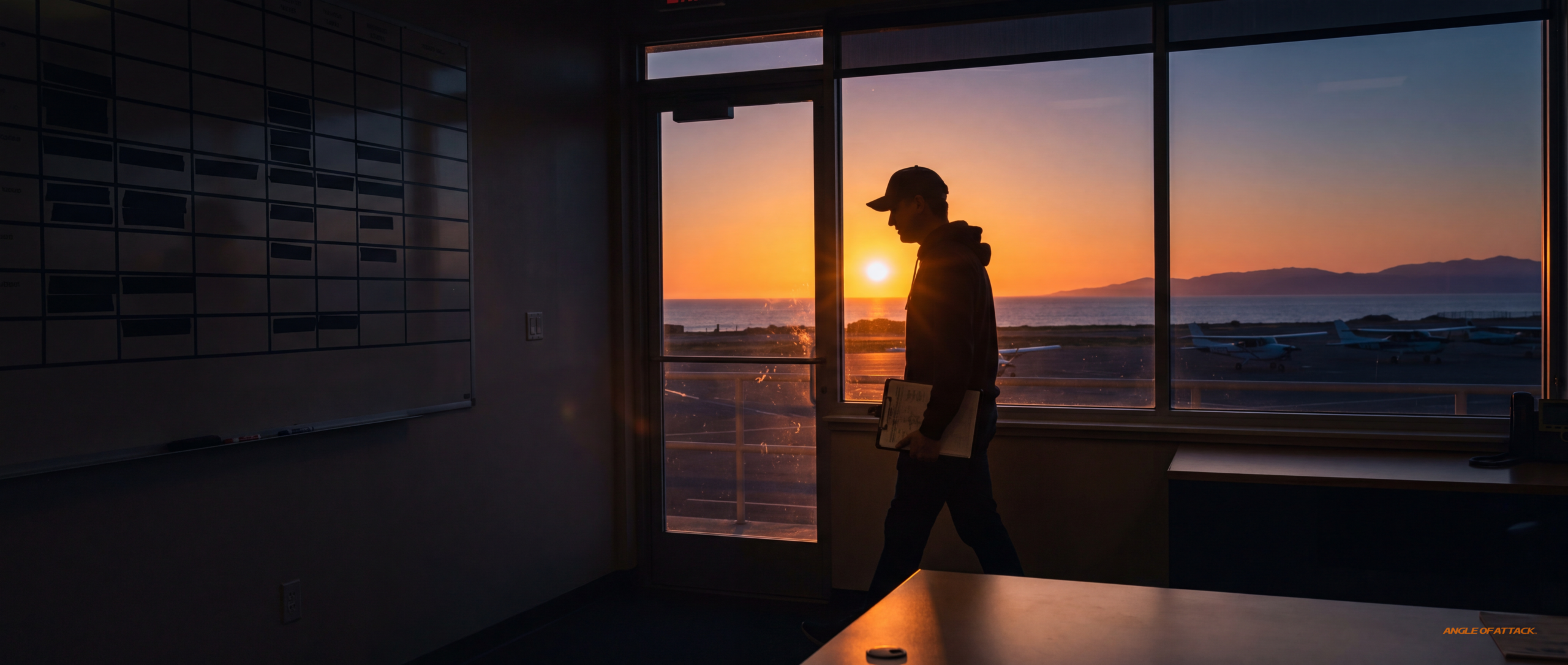
You’ll join roughly 138,000 active CFIs in the US, per FAA Civil Airmen Statistics (year-end 2024). A working day for a full-time CFI usually looks like this.
5:30–6:00 AM. Weather check, day plan. Look at the TAFs, the prog charts, the winds aloft for the airports you’ll touch today. Decide which lessons fly, which go to ground.
7:00 AM. First student. Pre-solo work, the 15 maneuvers. Pattern, slow flight, stalls, simulated engine-out on takeoff. One hour of flight, 30 minutes of debrief.
10:00 AM. Second student. Commercial maneuvers. Chandelles into lazy eights into a steep spiral. Two hours on the Hobbs, an hour of ground after.
1:00 PM. Ground lesson. Written-test prep for a Private student who’s two weeks from her knowledge test. Aerodynamics, weather, regulations, the whole load. Ground time is most of the teaching, not most of the schedule.
3:00 PM. Third student. Flight review for a returning Private pilot who hasn’t flown in nine months. One hour ground covering Part 91, one hour flight covering the maneuvers you select. Endorse the logbook.
5:00 PM. Wrap-up. Notes for tomorrow’s lessons, paperwork, schedule confirmations, the call back to the student who canceled at noon for tomorrow’s reschedule.
Then there’s the reality layer: cancellations from weather, sick students, mechanical squawks, the airplane that just came back from annual and needs a check flight before you can put a student in it. Most CFIs flying full-time do 4–6 flight hours plus ground on a normal day, and full-time CFIs commonly log 600 to 1,000+ hours of instruction per year.
One regulatory note worth memorizing: 14 CFR 61.195(a) caps you at 8 hours of flight training in any rolling 24-hour window. Total, across every student on your schedule. Not per student, not per calendar day, not duty time. Just flight training in a rolling 24. Ground training doesn’t count. Ferry flight doesn’t count. Simulator instruction counts only when it’s in a qualified flight simulator or flight training device.
The 8-hour cap isn’t a duty limit — it’s a fatigue floor. By hour 7 of teaching, you’re not at your best. And your best is what your student is paying for.
If you want the full picture of what your first month looks like (the student types, the schedule, the ground prep, the unwritten rules of being a new CFI at a real flight school), Section 1 of TotalCFI walks you through exactly that. Lessons 1.1 through 1.4 (Welcome to the CFI Track) frame the orientation: what a Day-1 ready CFI looks like, what the first 90 days actually feel like, and how to set your standards from the start.
Should You Add CFII and MEI? (And When)

Most new CFIs add the CFII within the first 12 months. The reason is market-driven: instrument students are the next-largest segment after Private students, and turning down instrument referrals leaves money and momentum on the table. The CFII checkride is shorter than the initial CFI (you’ve already proven you can teach), and the study load is mostly instrument-procedures and instrument-instructor responsibilities. If you got your CFI in Wisconsin in May, your CFII in Alaska by November is a realistic timeline. See A5, CFI vs CFII, for the deeper decision flow on this one.
MEI is the airline-pathway accelerator. Most regional airline minimums are written around multi-engine PIC time. If you’re using CFI work to build toward a Part 121 or 135 job, MEI is how you build multi-engine PIC fast. Teaching from the right seat counts. MEI work typically pays better hourly than basic CFI work because the airplanes cost more and the students are usually closer to the airline track. The downsides: multi-engine training is a smaller market, and the 5 PIC hours in make and model rule means you have to get current in each new twin before you can teach in it.
The order most candidates go is CFI, then CFII, then MEI. The smaller share goes CFI to MEI when their flight school has a strong multi-engine program. Either order is fine. The point is you don’t have to add everything at once. Add what your students actually need, in the order they need it.
E4, CFII privileges and limitations, and E5, MEI privileges and limitations, go deep on each one.
The One Privilege Most New CFIs Underestimate

Of the nine privileges listed in 14 CFR 61.193(a), the one with the heaviest weight is the one that gets the least attention in CFI prep: your signature on an endorsement.
The Aviation Instructor’s Handbook (FAA-H-8083-9B), Chapter 8, frames the CFI as the FAA’s representative in front of every student. That’s correct but it’s also abstract. The concrete version is this: every time you sign an endorsement, you are staking your certificate on that student’s readiness. Solo endorsement. Cross-country endorsement. Practical-test recommendation. Tailwheel sign-off. Complex sign-off. Every one of them carries your name and your reputation.
If a student you signed off goes out and breaks an airplane in a way that suggests the training was inadequate, the FAA is going to look at your logbook entries. If a checkride bust traces back to a gap you should have caught, the DPE is going to remember who recommended that applicant. The system has a memory, and your signature is the entry.
This is what Restorative Airmanship actually means in the CFI seat. Restorative Airmanship treats scope as an honest accounting of what you yourself have mastered, not a list of regulations to memorize. The reason you can only sign endorsements you hold is the same reason you should only recommend students you’d put your own family in the airplane with. Standards aren’t external. They’re internal. The signature is the receipt for an internal standard you’ve already met.
That moment is the start of being a CFI. Not the checkride. Not the certificate in your wallet. The first signature. Every endorsement after (pre-solo flight, cross-country, night, the practical-test recommendation) is downstream of the standard you set on the first one.
License to learn is the phrase I use most about the certificates we issue. A Private certificate is a license to keep learning, never an arrival. The CFI certificate works the same way. Your first 90 days are the start of your education as an instructor, not the end. The privilege most new CFIs underestimate is the one they exercise every single time they pick up the pen. The day you start treating that signature like the small ceremony it is, you stop being a checker of boxes and start being a mentor.
Mentoring a CFI candidate? This is the course I built for them.
Frequently Asked Questions
What can a CFI teach without a CFII?
Almost everything a pilot trains toward: student pilot through Commercial single-engine, flight reviews under 14 CFR 61.56, every endorsement the CFI personally holds, ground instruction, and "training to maintain or improve the skills of a certificated pilot" under the updated 14 CFR 61.193(a)(7). What's NOT in scope: instrument-rating training, instrument-proficiency checks under 14 CFR 61.57(d), instrument training for Commercial or ATP, and multi-engine training (that's MEI territory).
Can a CFI teach instrument flying at all?
Yes, partially. A basic CFI can teach the 3 hours of basic instrument flight required for the Private certificate under 14 CFR 61.109(a)(3). That's instrument time the student logs toward Private, not toward the instrument rating. What a basic CFI cannot do is train toward the instrument rating itself, give an IPC, or train the instrument portion required for Commercial. All of that requires the CFII add-on per 14 CFR 61.195(c).
Can a CFI teach in a multi-engine airplane?
Not without the MEI add-on plus 5 hours of pilot-in-command time in the specific make and model per 14 CFR 61.195(f). The 5-hour rule applies to every new make and model. Even after you have the MEI, you need 5 PIC hours in a Seminole before you can teach in a Seminole, and another 5 in a Seneca before you can teach in a Seneca.
Do CFIs teach ground school?
Yes. Ground instruction is included in the CFI privileges under 14 CFR 61.193(a). You don't need a separate ground instructor certificate (AGI/IGI) to teach written-test prep or formal ground school. Many CFIs do hold AGI/IGI for Gold Seal eligibility, but the ground-instruction privilege itself is already inside your CFI scope.
Can a CFI give a flight review?
Yes. Any current CFI in the appropriate category and class can give a 14 CFR 61.56 flight review: one hour of ground, one hour of flight, with the maneuvers and procedures selected by the instructor. The October 2024 update to 14 CFR 61.193(a)(7) made this even more explicit.
Can a CFI sign off a checkride?
A CFI signs the recommendation endorsement per 14 CFR 61.39. That's the entry in the student's logbook saying they're prepared for the practical test. The practical test itself is given by a Designated Pilot Examiner (DPE) or an FAA Inspector. The CFI doesn't issue certificates; the DPE does. New CFIs sometimes hear "signing him off for his checkride" and confuse the recommendation with the test itself. They're two different things.
If the CFI checkride is keeping you up at night, you're prepping for the wrong thing.
TotalCFI teaches you to walk into the oral as a teacher, not a test-taker — the reframe most candidates only figure out after they've already failed once.
Almost everything a pilot trains toward: student pilot through Commercial single-engine, flight reviews under 14 CFR 61.56, every endorsement the CFI personally holds, ground instruction, and “training to maintain or improve the skills of a certificated pilot” under the updated 14 CFR 61.193(a)(7). What’s NOT in scope: instrument-rating training, instrument-proficiency checks under 14 CFR 61.57(d), instrument training for Commercial or ATP, and multi-engine training (that’s MEI territory).